
What Is an SFP Module?
SFP (Small Form-factor Pluggable) is a compact, hot-swappable transceiver module commonly used for 1 Gigabit Ethernet (1G) connections.It supports both copper and fiber transmission and provides flexibility for different network distances and media types.

Typical SFP speeds:
-
1G Ethernet
-
1000BASE-T
-
1000BASE-SX / LX
What Is a 10G Network?
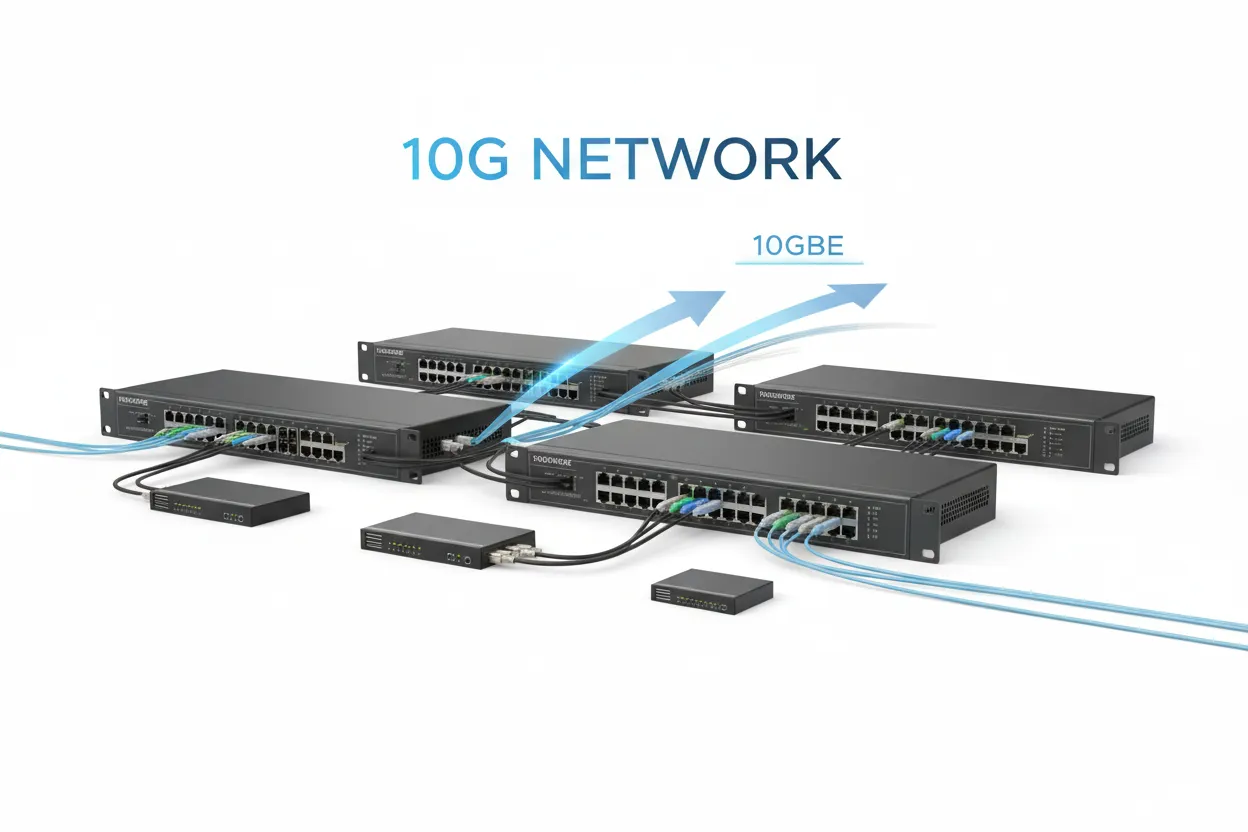
A 10G network refers to network infrastructure operating at 10 Gigabit Ethernet (10GbE) speeds.
The most common transceiver used in 10G networks is SFP+, which is an enhanced version of SFP designed specifically for higher bandwidth.
Typical 10G interfaces:
-
10G SFP+ SR / LR / ER
-
10G DAC
-
10G AOC
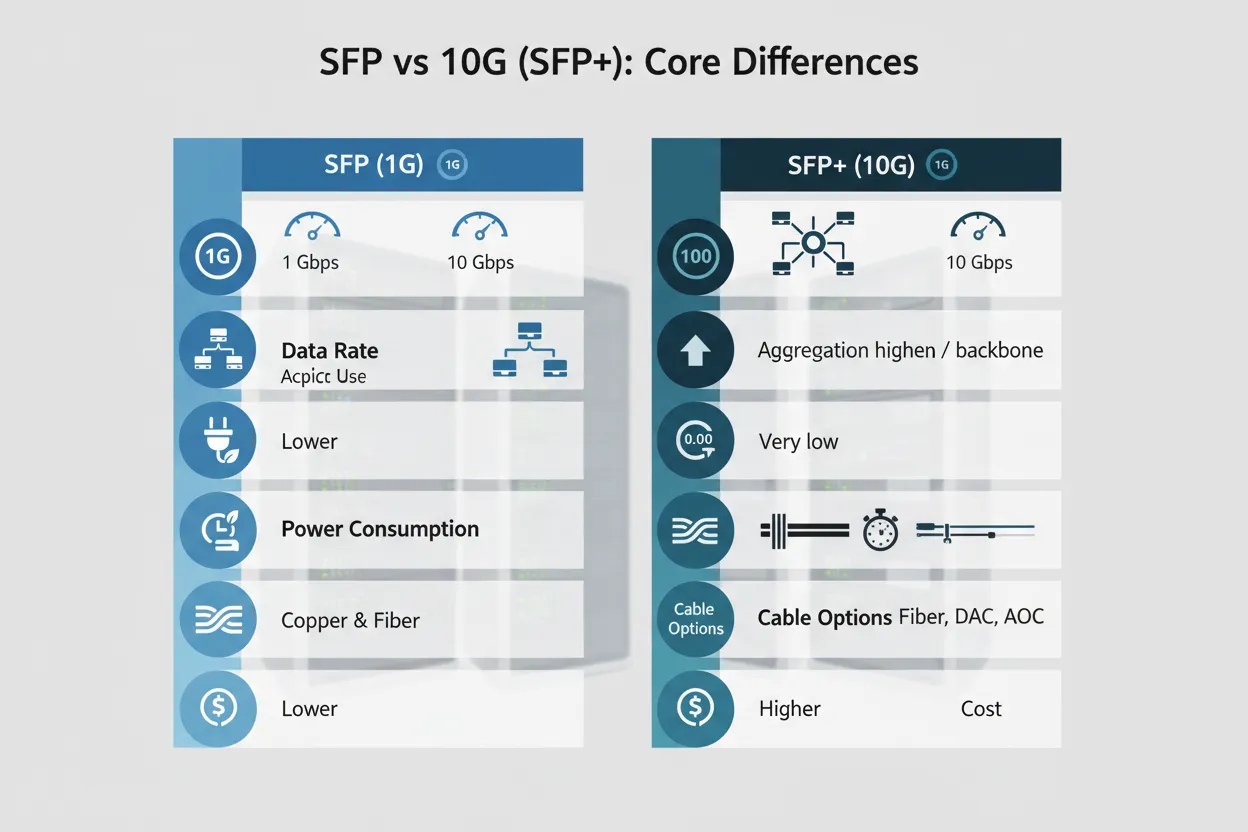
SFP vs 10G (SFP+): Core Differences
| Feature | SFP (1G) | SFP+ (10G) |
|---|---|---|
| Data Rate | 1 Gbps | 10 Gbps |
| Typical Use | Access networks | Aggregation / backbone |
| Power Consumption | Lower | Slightly higher |
| Latency | Low | Very low |
| Cable Options | Copper & Fiber | Fiber, DAC, AOC |
| Cost | Lower | Higher |
Performance and Application Comparison
SFP (1G) networks are suitable for:
-
Small offices
-
Legacy enterprise networks
-
Low-bandwidth applications
-
Cost-sensitive deployments
They offer sufficient performance where traffic demands are limited.
10G (SFP+) networks are designed for:
-
Data centers
-
High-density enterprise networks
-
Server aggregation
-
High-bandwidth applications
They provide significantly higher throughput and better scalability.
Cabling Considerations
From a cabling perspective:
-
1G SFP networks commonly use Cat5e/Cat6 copper or multimode fiber
-
10G SFP+ networks typically require Cat6A copper (short reach) or fiber optic cabling
As bandwidth requirements grow, fiber-based 10G solutions offer better distance support and EMI immunity.
Cost vs Future Scalability
While SFP (1G) solutions have a lower initial cost, they may become a bottleneck as network traffic increases.
10G networks require higher upfront investment but reduce the need for frequent upgrades and re-cabling.
For many modern networks, deploying 10G-ready infrastructure is a more cost-effective long-term strategy.
How to Choose Between SFP and 10G Network
When deciding between SFP and 10G, consider:
- Current bandwidth requirements
- Expected traffic growth
- Cabling environment
- Budget and upgrade cycle
A common approach is to use 1G at the access layer and 10G at the aggregation or backbone layer.
Frequently Asked Questions
Q: Can SFP modules work in SFP+ ports?
A:Yes, most SFP+ ports are backward compatible with 1G SFP modules.
Q: Is 10G always better than 1G?
A: Not necessarily. For low-bandwidth applications, 1G is often sufficient and more cost-effective.
Q: Does a 10G network require fiber only?
A:No. 10G can run on copper (Cat6A) for short distances or on fiber for longer links.
Conclusion
SFP and 10G networks are not competitors but solutions for different performance levels. Understanding their differences helps network designers balance cost, performance, and scalability. Choosing the right solution today ensures smoother network expansion tomorrow.

 English
  Spanish
  Arabic
  Portuguese