
In an age where ultra-fast internet, constant smart‑device connectivity, and seamless streaming are no longer optional, choosing the right in‑home network infrastructure is more critical than ever. Two major contenders emerge: FTTR (Fiber to the Room) and traditional Ethernet cabling (Cat5e/Cat6/Cat6A).
What Is FTTR (Fiber to the Room)?
FTTR means running optical fiber directly into each room of your home. Small optical ONTs or nodes are placed in every room, turning each room into a high-performance network hub.

Key Strengths of FTTR:
-
Massive bandwidth: Supports 10 Gbps and potentially more.
-
Extremely low latency: Faster response times for demanding applications.
-
Minimal signal loss: Fiber handles long runs without the attenuation that copper suffers.
-
Optimal Wi-Fi coverage: With an ONT in every room, Wi-Fi becomes more stable.
What Is Ethernet Cabling?
Ethernet cabling uses copper-based wires like Cat5e, Cat6, or Cat6A to deliver networking. It’s a well-established, reliable solution for wired devices throughout your home.
Key Strengths of Ethernet:
-
Stable connections: Ideal for PCs, TVs, NAS, and other stationary devices.
-
Cost-efficient: Copper cabling and related equipment are generally cheaper.
-
Easy deployment: Installing wall jacks and running Cat6A is simpler than full fiber.
-
Mature technology: Very well-understood, with lots of support and parts.

FTTR vs Ethernet: How They Compare
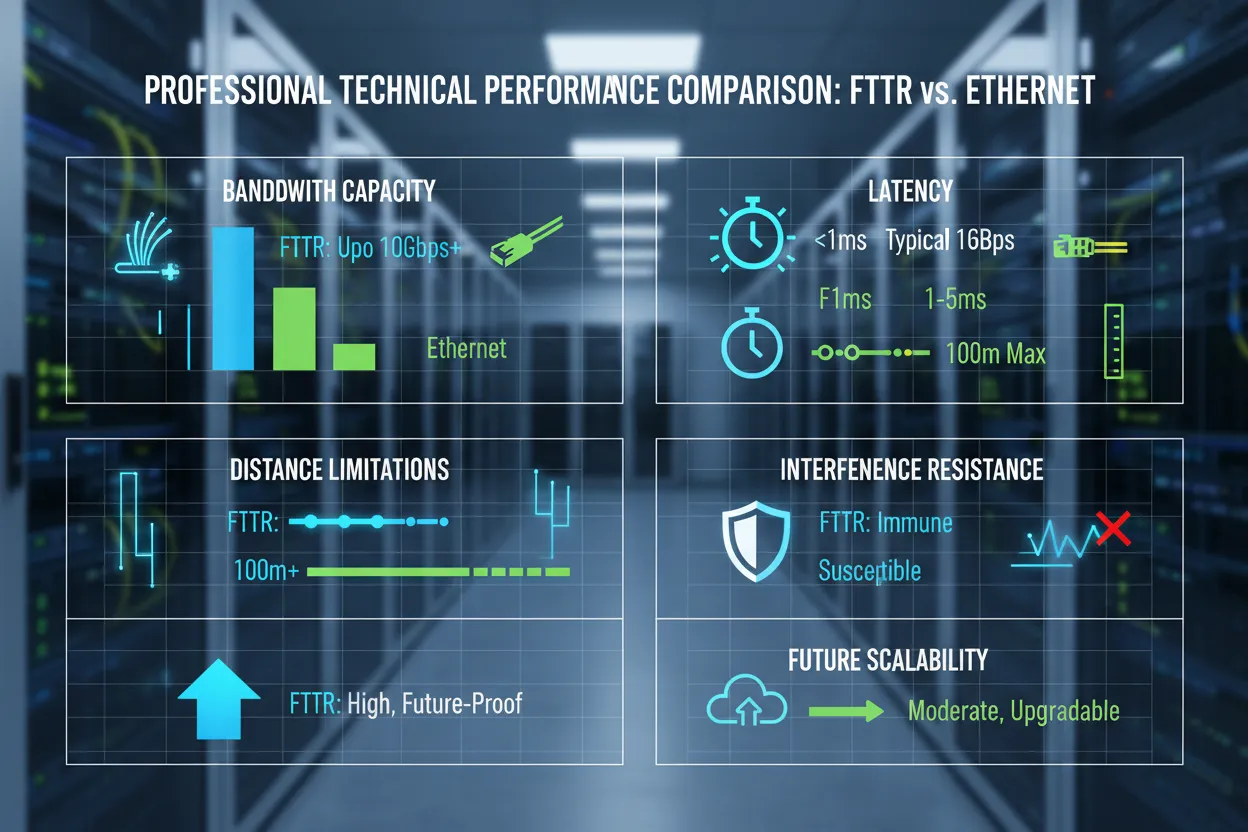
Here’s a side‑by‑side look at their strengths:
| Feature | FTTR | Ethernet Cabling |
|---|---|---|
| Maximum Speed | 10–40 Gbps | Up to 10 Gbps (Cat6A) |
| Distance Constraints | Virtually none | Copper suffers attenuation after ~50–70 m |
| Latency | Extremely low | Low, but higher than fiber |
| Wi‑Fi Coverage | Excellent | Depends on router location |
| Installation Difficulty | Moderate to high | Relatively simple |
| Future‑proofing | Very high | Good, but may require rewiring for big speed upgrades |
When to Choose FTTR
Opt for FTTR if:
-
Your room is large and suffers from Wi‑Fi dead zones.
-
You want to future‑proof for 10 Gbps+ speeds or heavy data use (gaming, 8K streaming, multiple NAS).
-
You want every room to have strong, consistent Wi‑Fi.
-
You’re okay with a more involved installation process.
When to Stick with Ethernet
Ethernet might be better if:
-
You need a budget-friendly and stable networking setup.
-
Most of your devices are plugged in (not dependent on Wi‑Fi).
-
You prefer simpler, faster installation.
-
You don’t plan to push your speeds beyond what Cat6A can support in the near future.
GCabling’s Recommendation
For the average modern home, a Cat6A Ethernet + Wi‑Fi 6/7 solution already delivers excellent performance at a solid value.For high‑end smart homes or future‑facing setups, consider a hybrid approach: FTTR for Wi‑Fi-intensive areas + Ethernet for wired devices.
Gcabling supports both architectures with a full product portfolio, including:
-
Optical fiber patch cords (e.g., MTP/MPO, LC)
-
Distribution and termination (ODF, fiber boxes)
-
Copper networking cables (Cat6, Cat6A)
Frequently Asked Questions
Q: Is FTTR future-proof?
A: Yes, fiber supports multi-gigabit speeds and upgrades mostly require changing equipment rather than cabling.
Q: Is installation of FTTR difficult?
A: Moderate to complex. It may require professional routing of fiber to each room. Ethernet is simpler to install.
Q: Which is cheaper, FTTR or Ethernet?
A: Ethernet is more cost-effective for installation. FTTR is more expensive due to optical nodes and fiber hardware.
Q: Can I mix FTTR and Ethernet ?
A: Absolutely. A hybrid setup is often ideal: FTTR for Wi-Fi coverage and Ethernet for wired devices.
Q:Can I use FTTR for gaming and streaming?
A:Yes. FTTR provides low latency and high bandwidth, perfect for 8K streaming, VR, online gaming, and multiple NAS access.
Q: What is the main difference between FTTR and Ethernet cabling?
A: FTTR delivers fiber directly to each room, providing ultra-high bandwidth and low latency. Ethernet uses copper wires, which are reliable but have speed and distance limitations.
Conclusion
Both FTTR and Ethernet are powerful networking strategies — but the right choice depends on your space, devices, and long-term vision. FTTR offers a future-ready, high-bandwidth setup, while Ethernet provides reliability, simplicity, and cost savings.
With Gcabling’s range, you don’t have to choose one or the other — you can create a network that blends the strength of both for a truly optimized experience.

 English
  Spanish
  Arabic
  Portuguese