
Large facilities such as airports, manufacturing plants, logistics centers, universities, and hospitals require surveillance systems that operate continuously and scale efficiently. While cameras and recorders often receive most of the attention, the true foundation of system reliability lies in the cabling infrastructure.
A poorly planned cabling design can lead to signal instability, voltage drop, overheating, and future upgrade limitations. A well-engineered structured cabling system, on the other hand, ensures long-term stability, easier maintenance, and expansion flexibility.
Planning the Surveillance Network Architecture
Before selecting cable types, define the overall topology:
-
Number of cameras per building or floor
-
Estimated bandwidth per camera (HD, 4K, AI-enabled analytics)
-
Centralized vs distributed recording
-
Distance between access points and control rooms
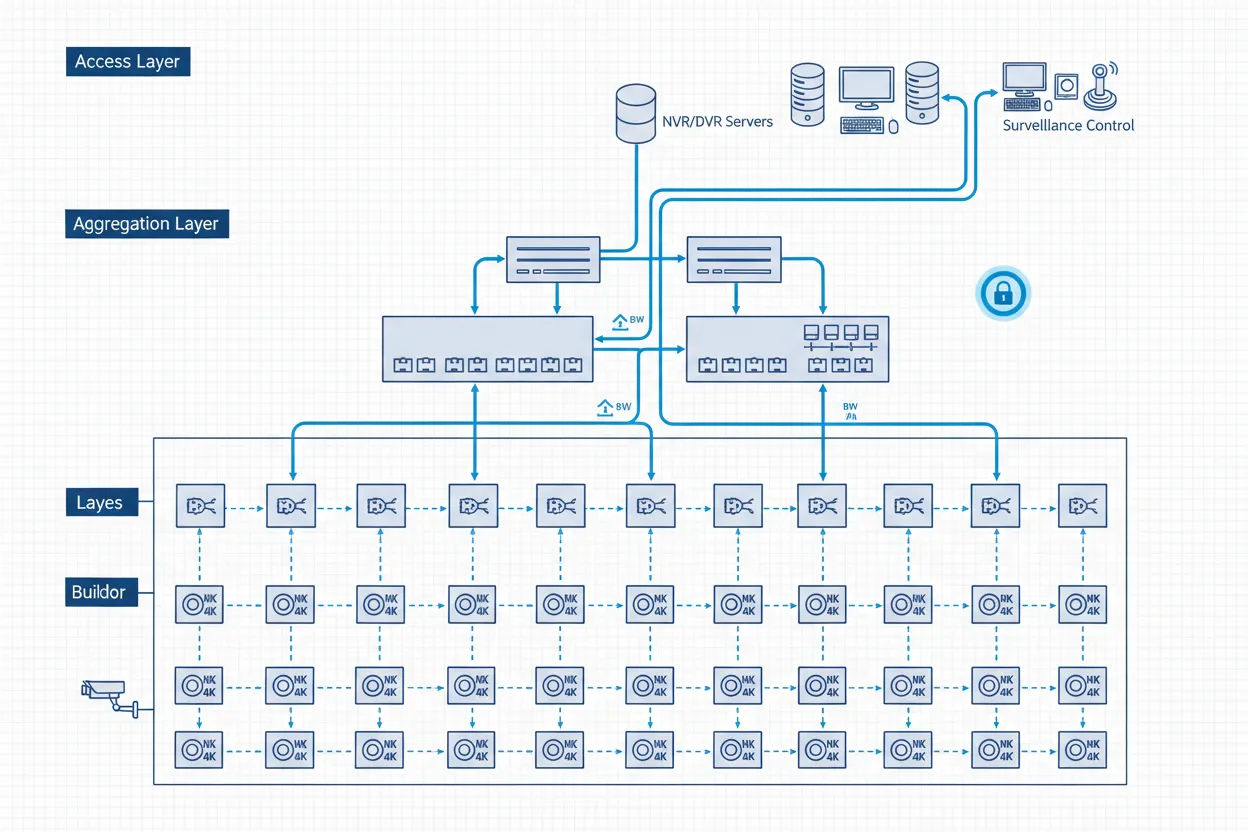
Most large-scale deployments follow a three-tier model:
Access Layer → Aggregation Layer → Core Layer
IP cameras connect to access switches via copper Ethernet. Aggregation switches connect to the core via fiber backbone. This hierarchical approach improves scalability and fault isolation.
Choosing the Right Cable Type
Horizontal Runs: Ethernet Copper Cabling
For individual camera connections:
-
Cat6 supports Gigabit transmission up to 100 meters
-
Cat6A provides improved shielding and better performance in dense cable bundles
-
23AWG conductors are preferred for high-power PoE applications
Copper is cost-effective and ideal for indoor floor-level camera deployment.
Backbone Connections: Fiber Optic Cabling
When connecting buildings, floors, or long corridors:
-
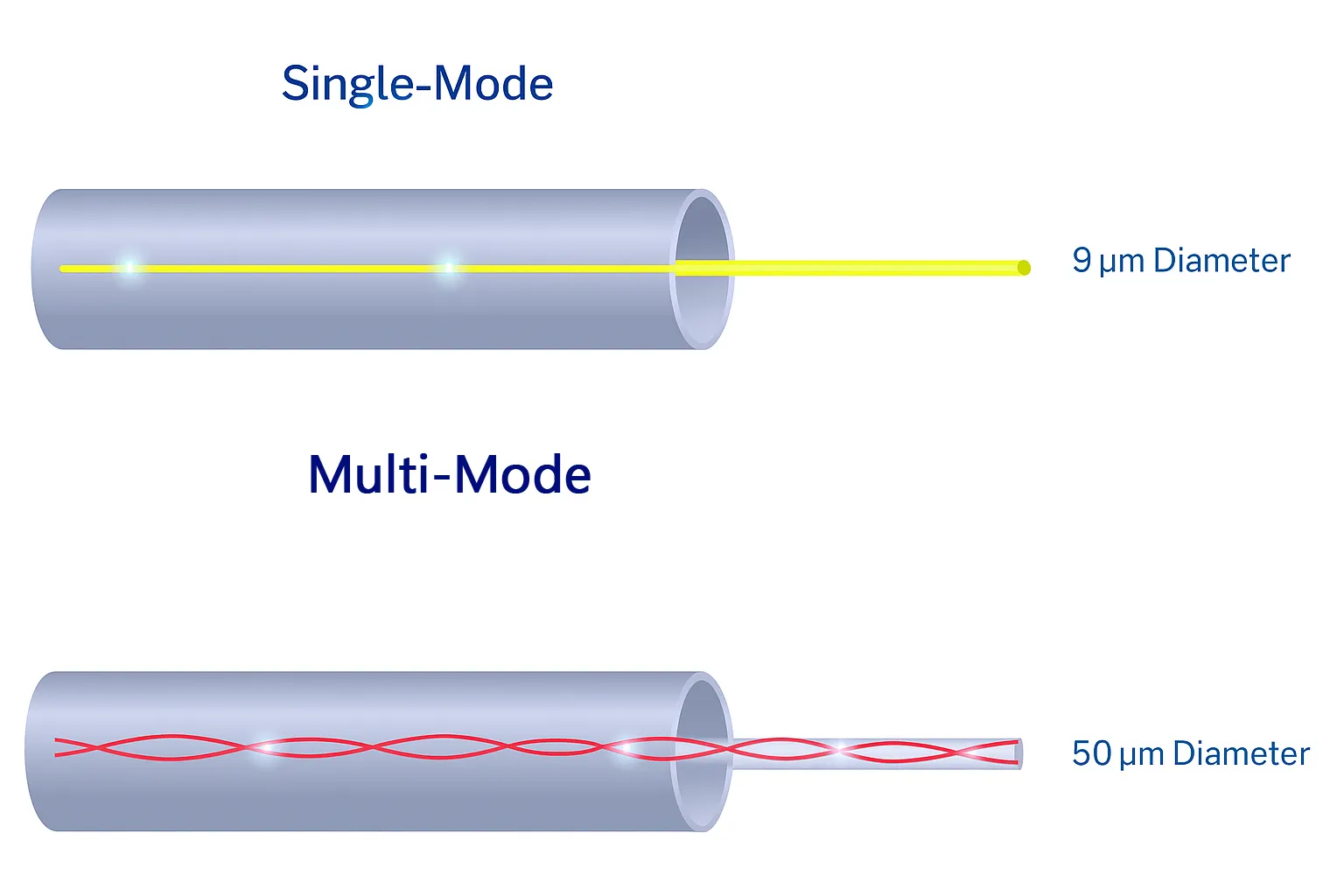
Single-mode fiber supports kilometer-level distances
-
OM3/OM4 multimode fiber works well for shorter campus links
-
Fiber eliminates electromagnetic interference concerns
For large facilities, fiber backbone infrastructure significantly enhances network resilience.
Power over Ethernet (PoE) Considerations
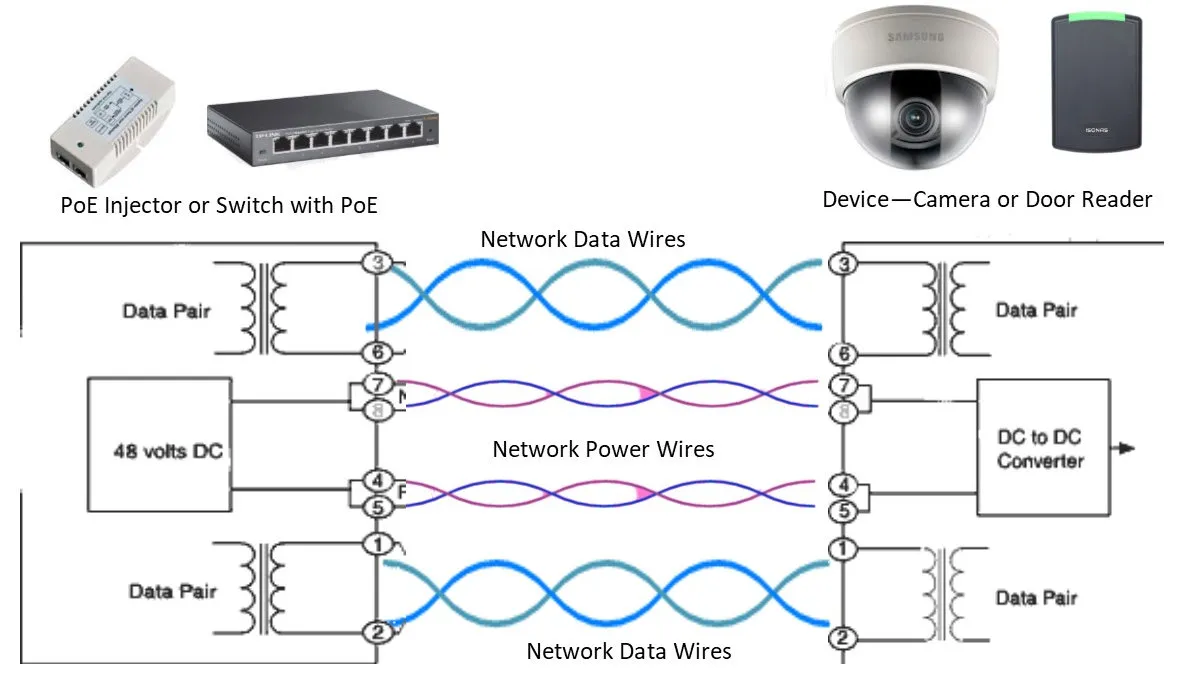
Modern IP cameras rely heavily on PoE technology standardized by
IEEE (802.3af, 802.3at, 802.3bt).
High-resolution PTZ cameras, infrared systems, and heater-equipped outdoor cameras may require PoE+ or PoE++.
Key design precautions:
-
Verify total switch power budget
-
Avoid excessive cable bundling to reduce heat accumulation
-
Maintain airflow inside racks
-
Ensure compliant patch panels and connectors
Improper PoE planning can result in unstable cameras and shortened cable lifespan.
Managing Distance Limitations
Copper Ethernet has a 100-meter channel limit. For larger properties, consider:
-
Installing intermediate switches
-
Converting long links to fiber
-
Using PoE extenders where appropriate
-
Designing telecom rooms per floor to shorten cable paths
Strategic equipment room placement reduces infrastructure strain.
Outdoor & Industrial Deployment Factors
Large facilities often include parking lots, perimeter fencing, and outdoor loading zones.
Outdoor installations require:
-
UV-resistant cable jackets
-
Gel-filled or armored fiber for moisture protection
-
Grounding and surge protection systems
-
Weatherproof enclosures rated IP65/IP67
Environmental durability is critical for uninterrupted surveillance coverage.
Rack Organization & Cable Management
Operational efficiency depends heavily on structured rack layouts.
Best practices include:
-
Clear cable labeling at both ends
-
Separation of power and data cables
-
Vertical and horizontal cable managers
-
Reserving at least 20% spare capacity
-
Documenting network layout for future troubleshooting
Organized racks reduce downtime and simplify system upgrades.
Scalability & Future Expansion
Large surveillance projects rarely remain static. Facilities expand, add cameras, or integrate AI-driven monitoring systems.
Future-ready planning includes:
-
Using higher-category cabling than minimum requirements
-
Deploying fiber backbone even if current demand is moderate
-
Selecting modular patch panels
-
Allowing headroom in PoE power budgets
Building scalability into the physical layer prevents costly re-cabling later.
Frequently Asked Questions
Q:How far can a PoE security camera run over Ethernet?
A: Standard Ethernet supports up to 100 meters. Beyond that, fiber or PoE extenders are recommended.
Q:Is Cat6 sufficient for 4K IP cameras?
A:Yes, Cat6 supports Gigabit speeds, which are adequate for most compressed 4K video streams. For higher-density deployments, Cat6A may provide additional reliability.
Q:When should fiber be used in CCTV systems?
A: Fiber is recommended for inter-building links, long-distance corridors, or environments with high electrical interference.
Q:Does cable quality affect camera image stability?
A:Yes. Poor-quality copper can cause voltage drop, packet loss, and intermittent connectivity, especially in high-power PoE installations.

 English
  Spanish
  Arabic
  Portuguese