Deploying a high-speed optical network requires precision. Unlike traditional copper Ethernet cables, which can withstand a fair amount of rough handling, fiber optic cables contain delicate glass strands that demand careful installation.
One of the most critical phases of network deployment is the physical routing of the wires. Whether you are wiring a massive data center or a smart home, pulling fiber optic cables through conduit is where the majority of permanent cable damage occurs.
As a premium brand dedicated to providing high-quality, finished optical network solutions, Gcabling has analyzed countless installation failures across the industry. In this guide, we will break down the five most common mistakes technicians make during the pulling process and show you how to protect your infrastructure investment.
Mistake #1: Exceeding the Maximum Pulling Tension
Copper cables use thick metal cores that can handle high tension. Glass fibers cannot. The most common way a cable is destroyed during installation is by simply pulling it too hard.
-
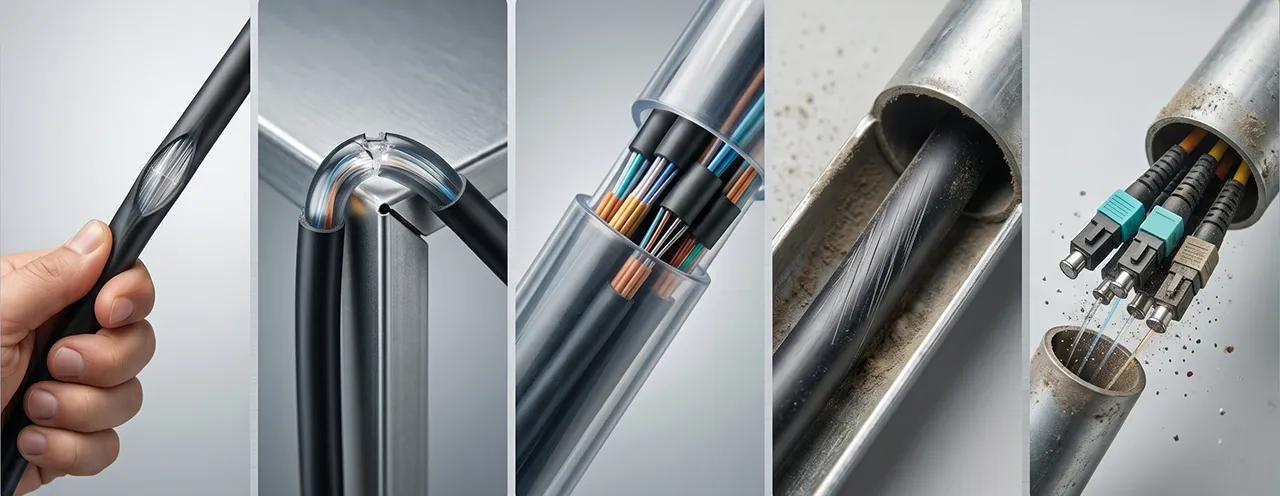
The Problem: Yanking a snagged cable or applying excessive force stretches the jacket and can snap the internal glass fibers, leading to a complete signal failure (often invisible from the outside).
-
The Fix: Never pull directly on the cable jacket or the delicate connector. Always attach your pull string or pull tape to the Kevlar aramid yarn (the strength member) inside the cable. For pre-terminated cables, use a specialized pulling eye mesh that distributes the tension evenly. Always check the manufacturer’s spec sheet for the maximum tensile load.
Mistake #2: Violating the Minimum Bend Radius
Glass can bend, but it cannot fold. When pulling fiber optic cables through conduit, navigating corners is the most dangerous part of the journey.
-
The Problem: Bending a fiber cable beyond its limit causes “micro-bending” or “macro-bending.” This allows the light signal to leak out of the glass core, causing severe signal attenuation or breaking the fiber entirely.
-
The Fix: Always respect the minimum bend radius. A general industry rule of thumb is that the bend radius under tension (during the pull) should be no less than 20 times the cable’s outer diameter. Once installed and at rest, it should be no less than 10 times the outer diameter. Use sweeping conduit bends (sweep elbows) rather than sharp 90-degree plumbing fittings.
Mistake #3: Ignoring Conduit Sizing and Fill Ratios
Trying to squeeze too many cables into a narrow pipe is a recipe for disaster.
-
The Problem: Overfilling a conduit dramatically increases friction. If cables are wedged together, pulling a new fiber through will generate heat and abrasion, potentially stripping the protective jacket off the cable.
-
The Fix: Follow the National Electrical Code (NEC) guidelines for conduit fill ratios. Generally, if you are pulling three or more cables, they should not take up more than 40% of the conduit’s internal cross-sectional area. This leaves 60% of the space empty to allow for heat dissipation and frictionless pulling.
Mistake #4: Pulling Without Proper Cable Lubricant
Friction is the ultimate enemy when routing cables through long, twisting underground or in-wall pipes.
-
The Problem: Pulling a dry rubber jacket against dry PVC or metal conduit over a long distance creates massive friction, increasing the pulling tension required and risking cable snaps.
-
The Fix: Always use a high-quality cable pulling lubricant. However, never use oil-based or generic hardware store lubricants, as they can degrade the fiber’s outer jacket over time. Use a specialized, water-based, or polymer-based optical cable lubricant that reduces friction and evaporates cleanly without leaving a sticky residue.
Mistake #5: Removing Dust Caps Before the Pull is Complete
If you are installing pre-terminated fiber (cables that already have LC, SC, or MTP connectors attached, such as Active Optical Cables), the connector heads are incredibly vulnerable.
-
The Problem: Removing the protective plastic dust caps before routing the cable exposes the microscopic ceramic ferrules to drywall dust, dirt, and moisture inside the conduit. A single speck of invisible dust on a fiber core can cause complete signal failure.
-
The Fix: Leave the factory dust caps on until the very last second. Only remove them when you are standing in front of the switch or patch panel, ready to plug the cable in. If a connector does get exposed, always clean it with a one-click fiber optic cleaner before mating it.
Conclusion
Successfully pulling fiber optic cables through conduit requires patience, the right tools, and an understanding of the physical limits of glass. By avoiding excessive tension, respecting the bend radius, and maintaining a clean environment, you can ensure your network operates at peak performance for decades.
At Gcabling, we engineer our finished fiber optic solutions to withstand the rigors of real-world installation. From ruggedized outdoor drop cables to premium pre-terminated MTP/MPO trunks designed for instant plug-and-play deployment, we provide the reliable branded products that IT professionals trust. Explore our comprehensive optical catalog today and build your network on a solid, high-performance foundation.
Frequently Asked Questions
Q: Can I use fish tape to pull a fiber optic cable?
A: Yes, you can use a fish tape to navigate the conduit first. However, do not tape the fiber directly to the stiff metal tip of the fish tape and pull hard. Instead, use the fish tape to pull a soft nylon pull-string through the conduit, and then use that pull-string to gently pull the fiber optic cable.
Q: How do you pull a pre-terminated fiber cable with connectors through a pipe?
A: You must protect the connectors. Never pull by the connectors themselves. Wrap the connectors in a staggered formation using electrical tape to keep the profile slim, attach a pulling eye or braided pulling mesh over the entire bundle, and attach your pull string to the mesh. Make sure your conduit diameter is large enough to accommodate the bundled heads.
Q: What happens if I accidentally pull a fiber optic cable too hard?
A: If you exceed the tensile strength, you may stretch the protective jacket and fracture the internal glass strands. The cable might look perfectly fine on the outside, but the network connection will fail. The only way to verify the cable’s integrity after a harsh pull is to test it with an OTDR (Optical Time-Domain Reflectometer) or a Visual Fault Locator (VFL).