
In an era defined by artificial intelligence (AI), 5G networks, and cloud computing, data has become the new global currency. The physical foundation supporting this massive data processing and storage is the modern data center.
For IT procurement directors and general contractors, understanding market trends and selecting the right physical infrastructure is absolutely critical. In this comprehensive guide, we will analyze the global data center market outlook and break down the essential physical components required to build a highly available, future-proof facility.
1. Global Data Center Market: Current Status & Verifiable Growth
We are currently witnessing an unprecedented surge in computing demand. The global data center landscape is rapidly evolving, driven by hyperscale expansion and AI integration. To understand the scale of this boom, let us look at the verifiable industry data:
-
Hyperscale Expansion: According to data tracked by Synergy Research Group, the total number of large data centers operated by hyperscale providers officially surpassed the 1100 mark globally by the end of 2025, with capacity doubling over the last four years.
-
Massive Market Valuation: Analyses by multiple authoritative institutions indicate that the global market for data center physical infrastructure currently stands at approximately $68 billion to $75 billion. Furthermore, it is projected to grow at a Compound Annual Growth Rate (CAGR) of 12.63% from 2026 to 2035.
-
AI-Driven Power Density: Historically, standard server racks consumed around 5 kW to 8 kW of power. However, the Uptime Institute reports that high-density racks designed specifically for AI training (such as those housing NVIDIA H100 GPU clusters) now routinely demand 30 kW to 50 kW per rack, creating severe physical challenges for cooling and weight bearing.
2. Core Physical Infrastructure for Modern Data Centers
A stable data center is much more than just a room full of servers. It is a highly precise ecosystem. To build a modern facility, you must invest in the following four core data center infrastructure solutions:
Heavy-Duty Server Racks
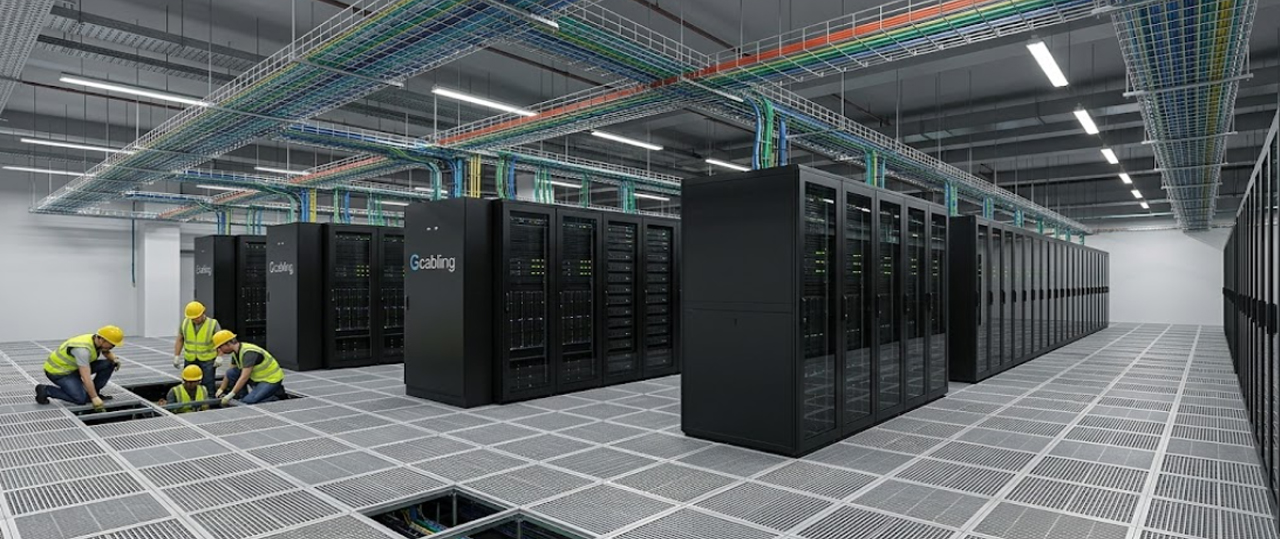
The server rack is the skeletal structure of the data center. Because AI servers and dense storage arrays are incredibly heavy, standard light-duty racks are no longer viable.
-
Key Requirements: Modern facilities require heavy-duty server racks manufactured from high-strength cold-rolled steel. They must support a verified static load capacity of at least 1,500 kg (approx. 3,300 lbs). Additionally, to facilitate proper hot/cold aisle containment, the front and rear doors must feature a high perforation rate of 75% or higher to maximize airflow.
Overhead Cable Trays
Disorganized cabling is a major fire hazard and severely blocks cooling airflow.
-
Key Requirements: Modern IT rooms utilize an “overhead cabling, underfloor cooling” architecture. By installing overhead cable trays (such as wire mesh trays or fiber optic raceways) directly above the racks, power lines and data cables are physically separated. This keeps the ceiling organized and makes future network expansion significantly easier.
Anti-Static Raised Floors
Data centers generate massive amounts of heat. Delivering cold air precisely to the equipment is the core of facility design.
-
Key Requirements: Installing an anti-static raised floor serves two critical purposes. First, it eliminates static electricity that could instantly destroy fragile motherboards. Second, it creates a massive “plenum” (pressurized air chamber) underneath the racks. Precision air conditioning (CRAC) pushes cold air through this plenum and up through perforated floor tiles directly to the front of the servers.
Smart PDUs (Power Distribution Units)
Electricity is the lifeblood of a data center, and the PDU acts as the heart valve.
-
Key Requirements: Standard power strips are entirely inadequate for enterprise use. Modern racks require a وحدة PDU الذكية. These advanced units provide industrial-grade surge protection and utilize network modules to monitor voltage, current, and Power Usage Effectiveness (PUE) in real-time. If temperatures spike or power overloads, the Smart PDU immediately triggers an alarm, enabling automated and remote IT management.
3. Infrastructure Component Quick Reference
To assist with your procurement planning, here is a quick comparison of essential components:
| Infrastructure Component | Core Function | Key Procurement Metric |
| Heavy-Duty Server Racks | Houses high-density IT equipment. | Static load > 1,500 kg; >75% perforated doors. |
| Overhead Cable Trays | Separates power and data cables. | High load capacity; open-mesh design for airflow. |
| Anti-Static Raised Floor | Prevents ESD; creates underfloor cooling plenum. | Certified anti-static veneer; strict point-load rating. |
| وحدة PDU الذكية | Distributes safe power; monitors real-time energy use. | Remote cascading; individual outlet metering; surge protection. |
4. Gcabling: Your Partner for One-Stop Data Center Procurement
Dealing with multiple vendors for complex equipment sizing often costs contractors valuable time and leads to integration errors.
Gcabling is dedicated to providing true one-stop data center procurement. From premium heavy-duty perforated racks and customizable overhead cable trays to precision-engineered anti-static raised floors and intelligent PDUs, our products are manufactured by the same trusted partner facilities that produce for world-renowned brands, guaranteeing exceptional quality and rigorous quality control.
We do not just sell standardized products; we offer deep customization based on your specific floor plan, power density, and cooling architecture (such as Cold Aisle Containment systems). By choosing Gcabling, you guarantee unified quality standards, faster delivery times, and a seamless engineering experience.
Whether you are constructing a multi-megawatt hyperscale facility or upgrading a corporate edge server room, contact the Gcabling expert team today. Let us help you build a solid physical foundation for your digital future.
الأسئلة الشائعة
Q: Why do modern data centers use an "overhead cabling, underfloor cooling" design?
A: This specific architecture maximizes cooling efficiency. By placing overhead cable trays above the racks, cables do not block the air vents at the bottom of the cabinets. Meanwhile, the anti-static raised floor acts as a pressurized plenum, allowing CRAC units to push cold air exclusively from the bottom up to cool the hot equipment. This drastically lowers the facility’s overall PUE (Power Usage Effectiveness).
Q: What is the difference between a Smart PDU and a basic rack power strip?
A: A basic power strip only provides electricity. In contrast, a وحدة PDU الذكية features a built-in network management module. It allows IT administrators to remotely monitor real-time energy consumption, voltage, and rack temperature. Furthermore, a Smart PDU allows admins to remotely reboot specific unresponsive server outlets, which is crucial for lights-out data center automation.
Q: What are the specific rack requirements for high-density AI data centers?
A: AI servers (especially those loaded with GPUs) are exceptionally heavy and generate extreme heat. Therefore, facilities must procure heavy-duty server racks with a static load rating of at least 1,500 kg (3,300 lbs). Furthermore, to support the massive airflow required for cooling these 30kW+ racks, the front and rear doors must feature a perforation rate exceeding 75%.

 Arabic
  English
  Spanish
  Portuguese