
As our homes become smarter, the demand for flawless internet coverage is reaching unprecedented levels. From 8K security cameras and immersive virtual reality (VR) headsets to smart appliances and automated lighting, a modern household can easily have over 50 devices connected simultaneously.
Historically, homeowners relied on a single router to handle this massive data load. However, as bandwidth requirements skyrocket, traditional wireless setups are hitting a physical wall.
To solve this, the telecommunications industry has introduced a revolutionary solution: Fiber to the Room (FTTR). In this comprehensive guide, we will explore what this technology is, why it is replacing traditional mesh networks, and how it is redefining smart home connectivity for the future.
1. What Exactly is Fiber to the Room (FTTR)?
To understand this new technology, we must first look at the current standard: FTTH (Fiber to the Home). In an FTTH setup, the high-speed fiber optic cable stops at the optical modem located in your living room or garage. From that single point, data is distributed throughout the house via Wi-Fi or older copper Ethernet cables.
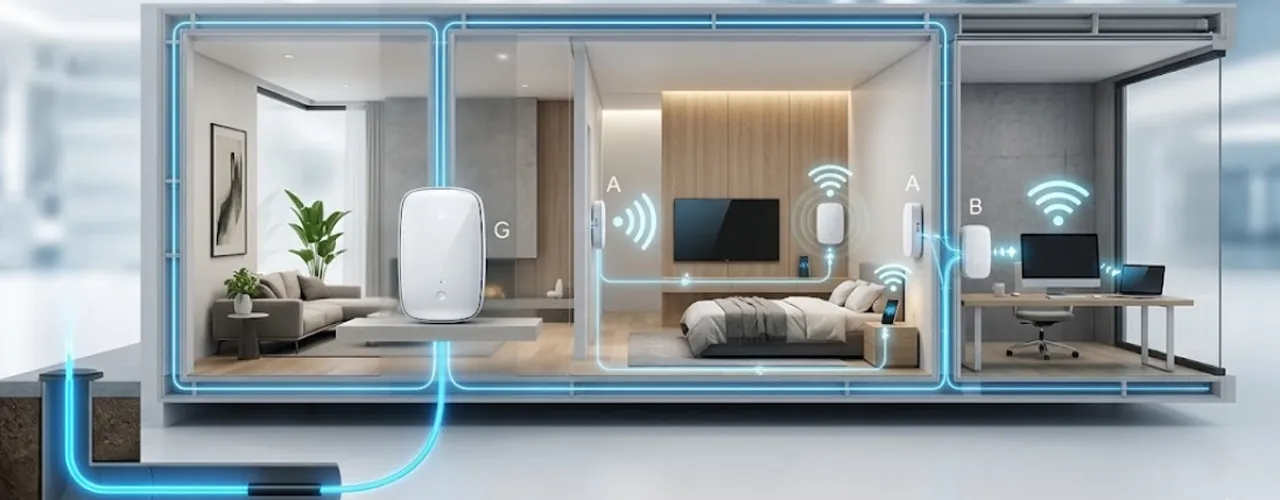
Fiber to the Room (FTTR) takes this concept a massive step further. Instead of stopping at the front door, optical fibers are routed directly into every individual room of the house. Each room receives its own dedicated optical router (or mini AP). Consequently, this creates a unified, ultra-high-speed network where gigabit speeds are delivered continuously, regardless of how many walls are between you and the main modem.
2. The Limitations of Traditional Smart Home Networks
Why is a standard Wi-Fi router no longer enough for a luxury smart home? The answer lies in the physics of wireless signals.
Modern routers utilize 5GHz and 6GHz frequency bands to deliver fast speeds. While these frequencies are incredibly fast, they suffer from terrible wall penetration. Concrete walls, metal ductwork, and even thick wooden doors absorb these signals, creating frustrating “dead zones” in bedrooms or basements.
Furthermore, traditional Wi-Fi mesh systems often suffer from high latency and speed degradation as the signal bounces from one room to another using wireless backhaul. FTTR eliminates this bottleneck completely by relying on light to transmit data through physical glass strands.
3. The Magic of Seamless Roaming: Zero Lag Across Rooms
One of the most impressive features of FTTR is its ability to provide truly “imperceptible” network switching. When you walk from the living room to the bedroom while on a video call or playing a mobile game, the network handoff happens in just 20 to 50 milliseconds (ms). Because human perception of network lag generally starts at 100ms, you will never notice the transition.
This seamless roaming is achieved through a perfect synergy between the unified fiber backbone and international roaming protocols:
-
The Unified Fiber Backbone: Unlike traditional Mesh routers that suffer from wireless transmission loss, all FTTR room routers are connected via optical fiber. This provides a 10Gbps+ lossless, zero-interference physical backbone. Furthermore, the master and slave routers automatically synchronize, projecting a single Wi-Fi name (SSID) across the entire house.
-
802.11k (Neighbor Reports – “Advanced Scouting”): As you walk away from the living room, your phone detects a weakening signal. The living room router immediately sends your phone a “neighbor report,” identifying the exact frequency and channel of the bedroom router. Your phone locks onto the next target without having to scan blindly.
-
802.11v (Network Steering – “Active Guidance”): Often, mobile devices act as “sticky clients,” stubbornly holding onto a weak signal. If you reach the bedroom but your phone is still clinging to the living room router, the FTTR smart controller actively intervenes. It forces the phone to disconnect from the weak signal and steers it to the much stronger bedroom router.
-
802.11r (Fast Transition – “Instant Authentication”): This is the crucial step for preventing lag. Standard network switching requires your device to re-enter passwords and re-authenticate, which takes hundreds of milliseconds. The 802.11r protocol allows the bedroom router to securely retrieve your phone’s encryption credentials via the fiber backbone in advance. When your phone switches over, it skips the authentication process entirely, reducing the delay to under 20ms.
4. FTTR vs. FTTH: Understanding the Difference
To clearly illustrate why integrators are making the switch, here is a quick comparison between the two network architectures:
| Feature | FTTH (Fiber to the Home) | FTTR (Fiber to the Room) |
| Fiber Termination Point | Stops at the main living room/entryway. | Extends into every single room. |
| In-Home Transmission | Relies heavily on Wi-Fi or copper cables. | Uses fiber optic cables for all backhaul. |
| Speed Consistency | Drops significantly behind thick walls. | Guarantees true 1000Mbps+ in every room. |
| Roaming Experience | Devices may temporarily disconnect. | Seamless (<50ms) microsecond roaming. |
5. Key Benefits of FTTR for Smart Homes
Upgrading to an all-optical home network offers several transformative advantages beyond just roaming speeds.
True Gigabit Speeds Everywhere
Because data travels through fiber optics at the speed of light, there is zero signal loss over distance. Whether you are gaming in the basement or streaming an 8K movie in the attic, you will receive the exact same gigabit speed as you would standing right next to the main router.
Invisible Installation Aesthetics
A common concern for luxury homeowners is the visual clutter of thick, ugly wires. Fortunately, FTTR utilizes specialized “invisible fiber cables.” These microscopic, transparent cables are thinner than a human hair and can be glued seamlessly along baseboards or doorframes, making the entire network virtually invisible without needing to drill holes in the walls.
Future-Proofing for Wi-Fi 7
As we step into the era of Wi-Fi 7, wireless routers will require massive backhaul bandwidth to function properly. Traditional copper Ethernet cables will soon become a bottleneck. Installing fiber optics throughout the home ensures your physical infrastructure is ready to handle 10Gbps or even 40Gbps speeds in the coming decades.
Conclusion: Upgrade Your Living Experience
The way we connect within our homes is fundamentally changing. Fiber to the Room (FTTR) is no longer just a luxury concept; it is rapidly becoming the gold standard for robust, interference-free smart home connectivity.
At Cabos G, we are dedicated to providing premium, finished optical solutions that bring this futuristic technology to life. From ultra-durable drop cables to transparent, aesthetic room-routing fibers, our products ensure your home network is built on a flawless foundation. Say goodbye to buffering and dead zones, and embrace the ultimate gigabit lifestyle today.
Perguntas mais frequentes
Q: Do I need to tear down my drywall to install FTTR?
A: No, you do not. One of the biggest advantages of FTTR technology is the use of transparent micro-fibers. Installers can route these nearly invisible cables along your existing baseboards, ceilings, or window frames using specialized thermal glue, completely avoiding destructive construction.
Q: Is FTTR better than a Wi-Fi Mesh system?
A: Yes, significantly. While Wi-Fi Mesh systems rely on wireless radio waves to communicate between nodes (which can be blocked by walls and suffer from interference), FTTR uses physical fiber optic cables to connect each room’s access point. This results in zero speed loss and enables the ultra-fast 802.11k/v/r roaming protocols to function perfectly.
Q: Can my existing devices connect to an FTTR network?
A: Absolutely. The optical routers placed in each room still broadcast standard Wi-Fi signals. Your current smartphones, laptops, and smart TVs will connect to the Wi-Fi exactly as they do now, but they will experience much faster and more stable internet.

 Portuguese
  English
  Spanish
  Arabic