
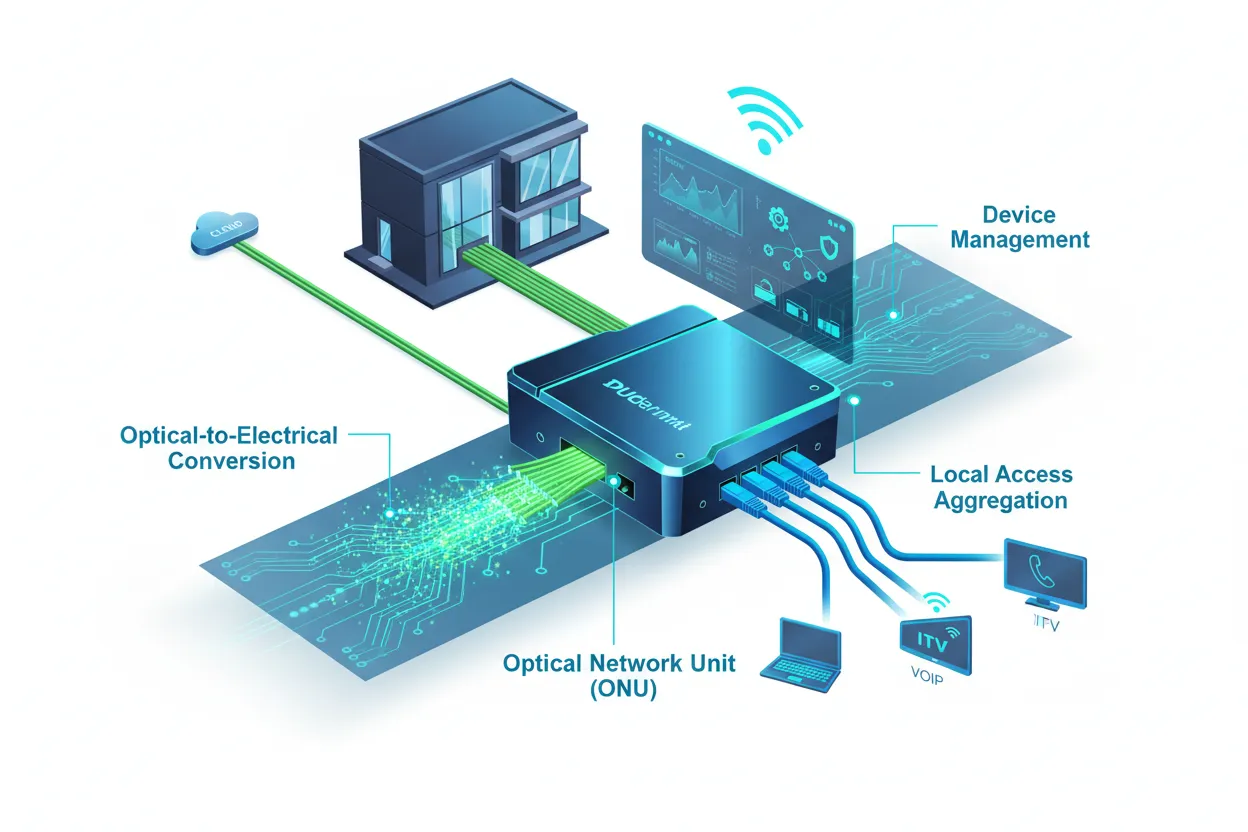
As fiber-to-the-home (FTTH) networks scale from pilot projects to mass rollouts, the Optical Network Unit (ONU) becomes a strategic device at the edge of service delivery. The ONU performs three core roles: optical-to-electrical conversion, local access aggregation (wired and wireless), and device/connection management. Proper ONU selection and deployment directly affect subscriber experience, operator operational costs, and the ability to introduce advanced services such as VoIP, IPTV and multi-SSID Wi-Fi.
What an ONU Does
An ONU sits at the customer premises (or at a subscriber aggregation point) and provides:
-
Signal conversion: Converts downstream optical frames into electrical Ethernet/Wi-Fi and upstream electrical traffic into optical signals toward the OLT.
- Network access gateway: Aggregates multiple user interfaces (Ethernet RJ45, POTS/RJ11, Wi-Fi) and enforces subscriber policies (QoS, VLANs).
- Device management & telemetry: Supports remote provisioning, firmware/patch updates, monitoring and alarm reporting.
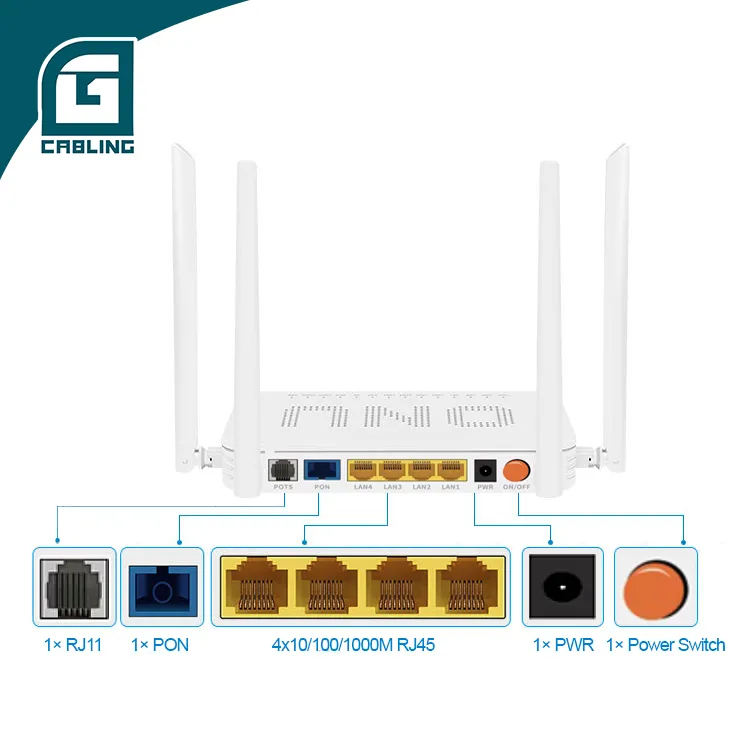
GCABLING P/N 25601-029-1 is an ONU offering 4 × 10/100/1000M Ethernet ports, dual-band Wi-Fi (2.4G & 5G), 1 × POTS (RJ11) and an EPON/GPON adaptive interface — illustrating the functional convergence expected from modern ONUs.
EPON vs GPON: Why Protocol Support Matters
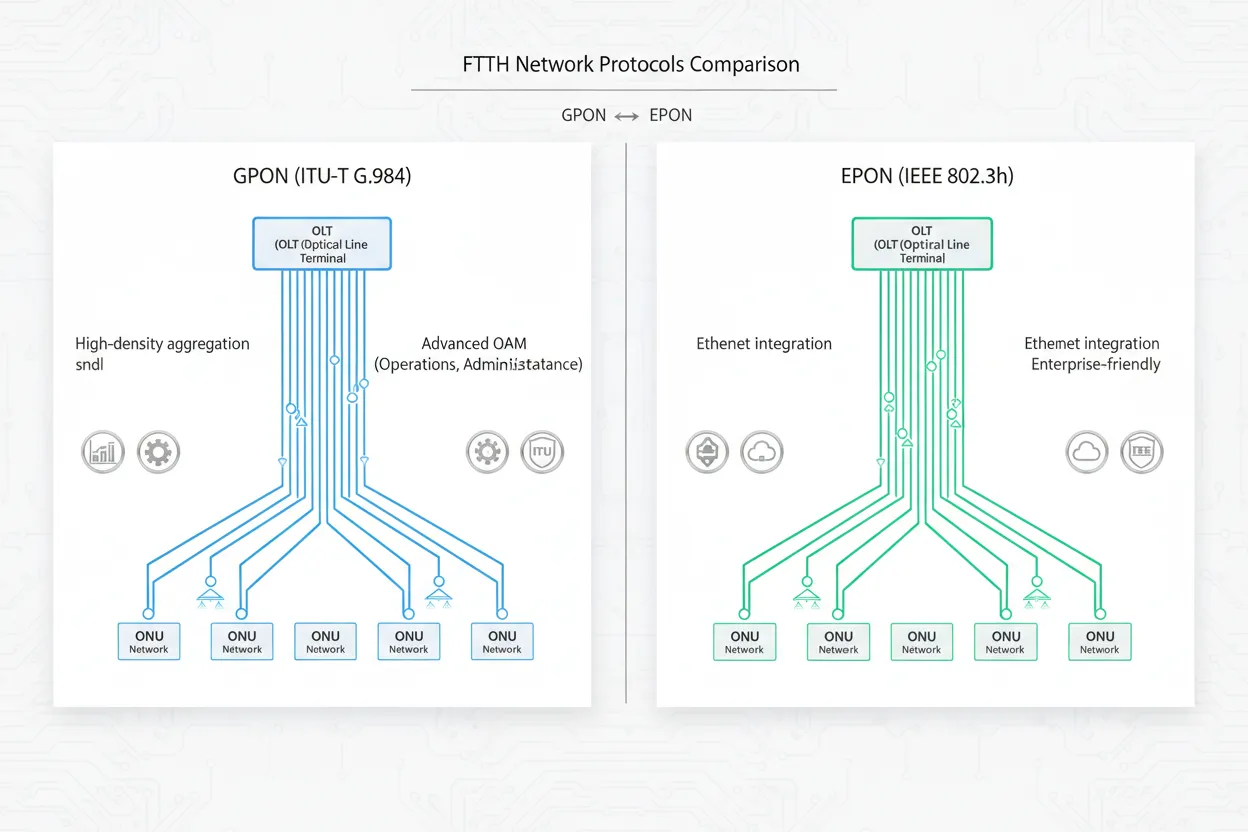
Two access protocols dominate FTTH access networks:
-
GPON (ITU-T G.984 family) — widely used for high-density subscriber aggregation, offers efficient bandwidth allocation and strong OAM support. Common in many telco deployments worldwide.
-
EPON (IEEE 802.3ah / 802.3av) — Ethernet-centric, easier integration with Ethernet backbones and equipment. Favored in some metros and enterprise environments.
Why ONU multi-protocol support helps: Devices that adapt to EPON and GPON give operators deployment flexibility (vendor neutrality, migration path) and simplify stocking and logistics. For example, an EPON/GPON-adaptive ONU reduces SKU proliferation for ISPs that operate mixed OLT fleets or migrate technologies over time.
Selecting an ONU
When evaluating ONUs for FTTH projects, prioritize the following:
Access interface and performance
-
-
Optical interface (single-mode fiber, SFP/SC/APC types), supported line rates and reach.
-
Downstream/upstream capacities and burst handling for realistic user profiles.
-
Subscriber interfaces
-
-
Number and speed of Ethernet ports (e.g., 4×Gigabit).
-
Integrated Wi-Fi capabilities (dual-band 2.4/5 GHz, MU-MIMO, WPA3 readiness).
-
Legacy service support (POTS/RJ11 for VoIP gateways).
-
Management & provisioning
-
-
TR-069, OMCI (for GPON), SNMP, CLI and RESTful APIs for remote provisioning and monitoring.
-
Support for zero-touch provisioning and bulk configuration templates.
-
QoS and multi-service support
-
-
Per-port and per-flow QoS (policing and shaping), VLAN tagging/translation, IGMP snooping for multicast IPTV.
-
Ability to implement SLAs and hierarchical queuing.
-
Security and resilience
-
-
Secure firmware update mechanisms, account hardening, management access controls.
-
Power options (AC, optional DC or battery backup) and watchdog features.
-
Operational attributes
-
-
Physical form factor, thermal profile, packaging for field installation.
-
Vendor support for software maintenance, RMA processes and interoperability certification.
-
Deployment & Design Best Practices
Operators and integrators should follow these practical rules:
-
Plan for Hybrid Architectures: Use fiber ONUs for the access/backbone and copper (structured cabling) at the final 10/100/1000M drop if cost-sensitive — but rely on fiber when higher bandwidth or longer reach is required.
-
Centralize Management: Use a unified provisioning platform (TR-069/ACS for CPE or OMCI for GPON) to minimize manual configuration and OPEX.
-
Pre-define QoS Profiles: Prepare service templates (e.g., basic broadband, IPTV bundle, premium gaming) with VLANs and QoS rules to accelerate customer turn-up.
-
Validate Wi-Fi planning: For ONUs with integrated Wi-Fi, conduct AP placement and spectrum planning. Consider mesh or external APs for high-density homes/offices.
-
Test real-world traffic conditions: Validate ONU behavior under bursty traffic (P2P, cloud backup), multicast IPTV loads, and simultaneous Wi-Fi streaming to identify congestion points.
-
Security & firmware governance: Enforce signed firmware, rolling updates and vulnerability scanning; keep OTA update windows outside peak hours.
Service Assurance & Troubleshooting
A mature operations model includes:
-
Remote diagnostics: Link status, SNR/OLT reports, ONU logs available to NOC staff.
-
Topology mapping: Auto-discovery of ONUs and correlation with OLT splitters for fault isolation.
-
SLA monitoring: Track latency, packet loss and throughput per subscriber; use alarms for SLA breaches.
-
Fallback & field procedures: Clear RMA, swap and replacement SOPs for in-home or curb-side units.

Business & Commercial Considerations
-
Inventory efficiency: Favor adaptable ONUs (EPON/GPON) to reduce SKUs and simplify procurement.
-
Total cost of ownership (TCO): Consider the trade-off between higher ONU capex (better Wi-Fi, multi-services) and lower downstream opex (reduced truck rolls via remote management).
-
Future proofing: Select ONUs with firmware upgrade capacity and modularity to support emerging standards (e.g., enhanced Wi-Fi, IPv6, new multicast codecs).
الخاتمة
The ONU is more than an optical modem — it is the subscriber gateway that shapes user experience and operational economics in FTTH networks. For ISPs and system integrators, careful selection, robust provisioning, and proactive management of ONUs are essential to scale FTTH services successfully. Devices such as GCABLING P/N 25601-029-1 illustrate the modern ONU feature set: multi-Gigabit Ethernet ports, dual-band Wi-Fi, POTS support and EPON/GPON adaptability — all of which help operators deliver reliable, high-value services.
الأسئلة الشائعة
Q: What is the difference between an ONU and an ONT?
A: Terminology varies: ONT (Optical Network Terminal) often refers to customer premises devices; ONU (Optical Network Unit) is a broader term that may include ONTs or devices at curb/MDU aggregation. Functionally both perform optical-to-electrical conversion and subscriber aggregation.
Q: Should I choose EPON or GPON ONUs?
A: Choose based on existing OLTs and business requirements. GPON offers efficient bandwidth allocation and telco adoption; EPON is Ethernet-native and can simplify integration with Ethernet networks. Multi-protocol ONUs provide flexibility.
Q: How important is remote provisioning?
A: Critical — remote provisioning (TR-069, OMCI) reduces truck rolls and accelerates mass rollouts. Ensure ONUs support automated, secure zero-touch provisioning.
Q:Do ONUs need battery backup?
A: For voice services (POTS) or critical IoT applications, consider UPS or battery options. For pure broadband-only deployments, battery backup is usually optional and depends on operator SLAs.
Q:How many subscribers per PON port?
A:Typical split ratios are 1:16, 1:32, or 1:64. Choose ratios based on required per-user bandwidth, oversubscription policy and OLT capacity.

 Arabic
  English
  Spanish
  Portuguese