
As cities continue to evolve into smart, interconnected ecosystems, buildings are transforming from simple concrete structures into intelligent environments where lighting, security, HVAC, and communication systems seamlessly interact through a unified network. To achieve this high level of integration, cabling infrastructure must support not only high-speed data transmission and long-distance communication but also stable power delivery.
This is precisely where hybrid copper-fiber solutions come into play. By effectively combining the ultra-fast data transfer capabilities of fiber optics with the reliable power delivery of copper, these solutions are bridging the gap between performance and practicality—redefining how modern smart buildings are designed, connected, and sustained for the future.
Why Hybrid Cabling Is the Future of Smart Infrastructure
Traditional copper cables, while widely used and cost-effective, nevertheless face limits in both data rate and distance. By contrast, pure fibre systems excel in data transmission and offer exceptional bandwidth, yet they require separate power infrastructure for connected devices. To overcome these challenges, hybrid cabling effectively bridges the gap. Specifically, it integrates fibre strands for high-speed data transmission together with copper conductors for power delivery within a single sheath, thereby enabling both performance and efficiency in one unified solution.making it ideal for:
-
Smart lighting and surveillance systems
-
Digital ceilings and access control
-
IoT sensors distributed across large campuses
-
Edge computing or PoE++ devices requiring 60–90W
The result is a cost-effective, flexible network that supports both current and future smart building.

Building a Hybrid Architecture
Modern smart buildings increasingly adopt a “fiber-to-the-edge” (FTTE) structure. In this architecture, fibre backbones extend ever closer to the workspace, thereby minimizing signal loss and ensuring more stable high-speed transmission. At the same time, hybrid or copper cables take over for the last few meters of connection and power delivery, thus creating a seamless link between the network core and end devices.Key architectural models include:
- Hybrid Trunk Cables: Fibre and copper combined in one cable for data and power.
-
Zone Distribution: Intermediate nodes or consolidation points to simplify changes and upgrades.
-
PoE Integration: Using copper conductors with hybrid systems to power access points and IoT devices.
This hybrid structure provides both bandwidth scalability e installation simplicity, which are critical for smart buildings aiming to stay adaptable.

Gcabling’s ONU and PoE Switch: The Perfect Hybrid Companions
To make hybrid networks even more efficient, Cabos G introduces its latest active network components — the Gcabling ONU (Optical Network Unit) e PoE Switch series.
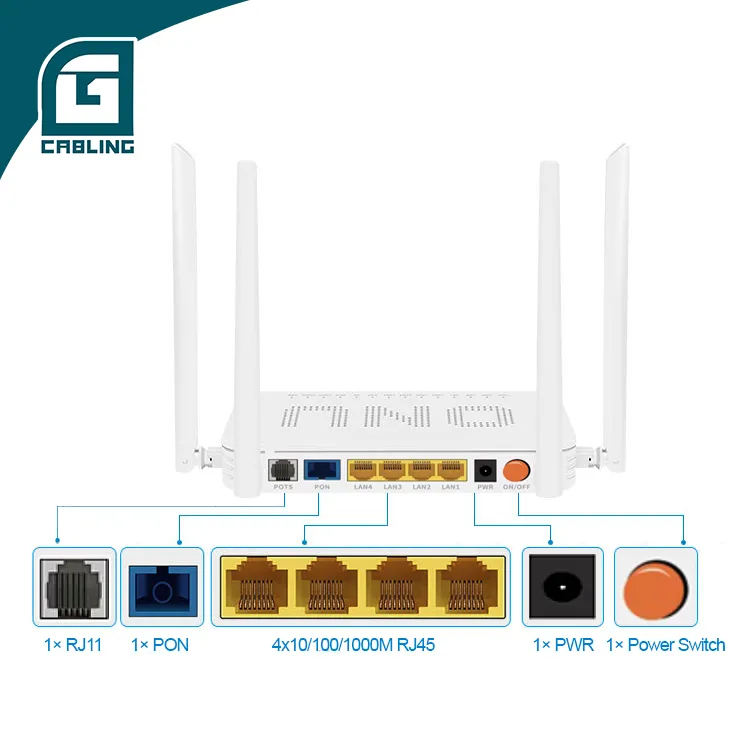
Gcabling ONU
Engineered for advanced GPON, XPON, and 10G-PON architectures, the Gcabling ONU is specifically designed to deliver high-performance optical-to-electrical signal conversion for both residential and enterprise networks. With its optimized design, it ensures reliable fibre access and, in turn, consistent data throughput. Moreover, it enables seamless integration with existing broadband systems, thereby providing a stable and future-ready gateway for high-speed connections.
Gcabling POE Switch
The Gcabling PoE Switch series provides both power and data transmission through Cat cables, fully compliant with the IEEE 802.3af/at PoE standard. Each PoE port supports auto-sensing to automatically detect and supply power to compatible PD devices, and it stops power output safely when the device is disconnected.
Built for stability and simplicity, these feature:
-
Automatic PoE voltage detection
-
Full-duplex communication
-
Auto uplink cable recognition
-
Reliable and cost-effective design
Ideal for wireless access points (APs), IP cameras, and network systems, this ensures dependable power delivery up to 20km via fiber uplink.


Advantages of Hybrid Copper-Fibre Cabling
-
Extends data and power transmission distances up to several hundred meters
-
Simplifies installation—one cable does the job of two
-
Supports high-power PoE++ without overheating or voltage loss
-
Reduces maintenance costs through a modular design
-
Meets environmental standards such as RoHS e REACH
These benefits make hybrid cabling a strategic choice for network designers and contractors working on high-performance smart building projects.
Future Trends
With the rapid rise of IoT applications, AI-driven building management systems, and 5G backhaul networks, it is clear that hybrid copper-fiber solutions will continue to play an essential role in next-generation connectivity. Specifically, while fiber ensures that networks remain scalable and capable of supporting ultra-high-speed communication, copper, on the other hand, brings the inherent ability to deliver power efficiently, thereby keeping smart devices operating smoothly—all of this achieved without the need for additional infrastructure.
As more organizations seek to upgrade their building networks, hybrid architectures supported by Gcabling’s ONU e PoE switches will form the backbone of intelligent connectivity.
Final Thought
Looking ahead, the future of smart buildings clearly depends on networks that are not only fast and efficient but also intelligent and adaptive. In this context, hybrid copper-fiber cabling, when combined with Gcabling’s advanced ONU and PoE switch lineup, offers the perfect foundation for this evolution. Indeed, it’s more than a means of connectivity,rather, it serves as the backbone of tomorrow’s intelligent spaces.
Perguntas mais frequentes
Q: Are Gcabling’s ONU and PoE switches compatible with other brands?
A: Yes. Gcabling’s ONU supports GPON, XPON, and 10G-PON standards and integrates smoothly with most OLT systems. The PoE switch can work with any Ethernet-based device.
Q: What certifications should hybrid cabling meet?
A: Always look for CE,RoHS, and UL certifications to ensure safety and compliance. Gcabling products meet or exceed all major international standards.

 Portuguese
  English
  Spanish
  Arabic