
Gcabling | Network Infrastructure Solutions & Products Supplier
Welcome to be our agent!
Introduction: The Backbone of Fiber Connectivity
Fiber optic patch cords, also known as fiber jumpers, are essential components in high-speed data transmission networks. Their performance directly impacts signal quality, insertion loss (IL), and return loss (RL). At Gcabling, our advanced manufacturing and strict quality control processes ensure that every patch cord meets international standards and customer expectations.
Step-by-Step Manufacturing Process of Fiber Patch Cords
Step 1: Material Preparation
Select the appropriate fiber type (single-mode or multi-mode), connectors (SC, LC, FC, MTP), and jacket material (PVC, LSZH) based on application needs.
Step 2: Precision Cutting
Fiber cables are cut to required lengths using automated cutting machines for consistent output and high efficiency.
Step 3: Stripping & Cleaning
Remove the outer jacket and buffer coating (typically 3.0mm, 2.0mm, or 0.9mm), then clean the fiber with alcohol to eliminate dust and residues.
Step 4: Epoxy Application & Curing
Inject epoxy into the connector ferrule, insert the cleaned fiber, and cure the assembly in an oven to secure bonding.
Step 5: Connector Assembly & Polishing
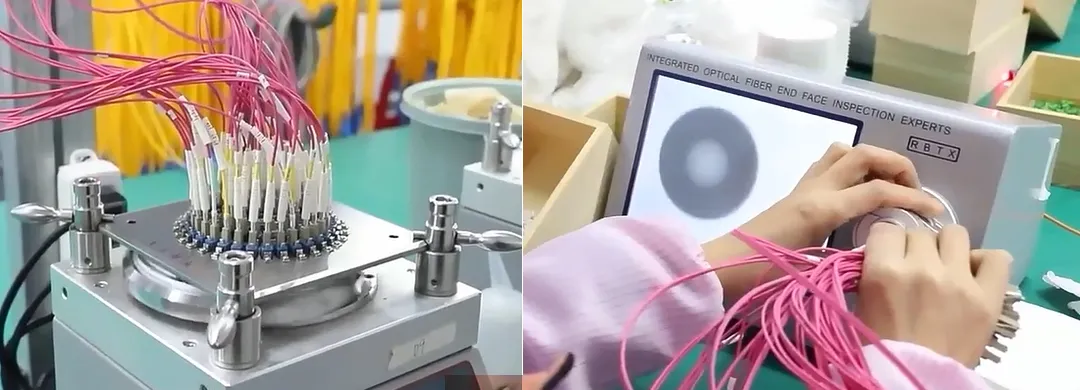
Assemble the connector housing and strain relief boot, then polish the ferrule end-face with automatic machines and clean it using ultrasonic equipment.
Step 6: Inspection & Testing
Inspect end-faces under a 400x microscope for scratches or contamination. Perform insertion loss (IL) and return loss (RL) testing to ensure performance meets standards.
Quality Control and Testing Procedures
1. 3D End-Face Geometry Inspection
Using interferometers, we inspect:
-
Apex offset
-
Radius of curvature
-
Fiber height
-
Ferrule angle
This ensures optical performance and connector durability.
2. Insertion Loss (IL) and Return Loss (RL) Testing
Each patch cord is tested under calibrated equipment:
-
IL must typically be ≤ 0.4dB for SM, ≤ 0.5dB for MM
-
RL must exceed 55dB for APC, 35dB for UPC
Gcabling uses automated IL/RL test stations to guarantee consistency and minimize human error.
3. MPO/MTP Specific Testing
MPO patch cords are tested for:
-
Polarity
-
End-face cleanliness
-
Individual fiber alignment (with 12F/24F test heads)

Gcabling’s Commitment to Quality and Standards
At Gcabling, quality is controlled at every stage using ISO 9001-certified systems, including:
-
IQC (Incoming Quality Control) for materials
-
IPQC (In-Process QC) during polishing and assembly
-
FQC (Final QC) before packaging
-
OQC (Outgoing QC) before shipment
All patch cords are 100% tested and traceable with serial numbers and test reports.

Conclusão
From fiber cleaving to IL/RL testing, every step in the patch cord manufacturing process plays a vital role in overall network performance. With Gcabling’s in-house capabilities and rigorous quality assurance, you can trust every jumper to deliver stable, high-speed optical transmission.

 Portuguese
  English
  Spanish
  Arabic