
As network architectures continue to expand toward higher bandwidth, longer transmission distances, and intelligent power delivery, traditional cabling methods are becoming increasingly inefficient. In particular, the separate installation of optical fiber for data and copper cable for power not only increases material costs but also complicates system design and maintenance. Moreover, managing two distinct cabling systems can lead to longer installation times and higher potential for errors. Therefore, more integrated cabling solutions are emerging as a practical alternative, offering both cost savings and simplified network management. The Gcabling Photoelectric Hybrid Patch Cord offers a more streamlined solution by integrating data transmission and power supply into a single cable assembly.
What Is Photoelectric Hybrid Patch Cords?
A photoelectric hybrid patch cord combines single-mode optical fiber with copper power conductors in one unified cable. Specifically, the optical fiber supports high-speed data transmission and offers strong immunity to electromagnetic interference. Meanwhile, the copper cores deliver stable DC power efficiently.This design supports PoE, PoE+, and PoE++ standards, operating within a 48–56V DC range, making it suitable for a wide range of powered network devices.
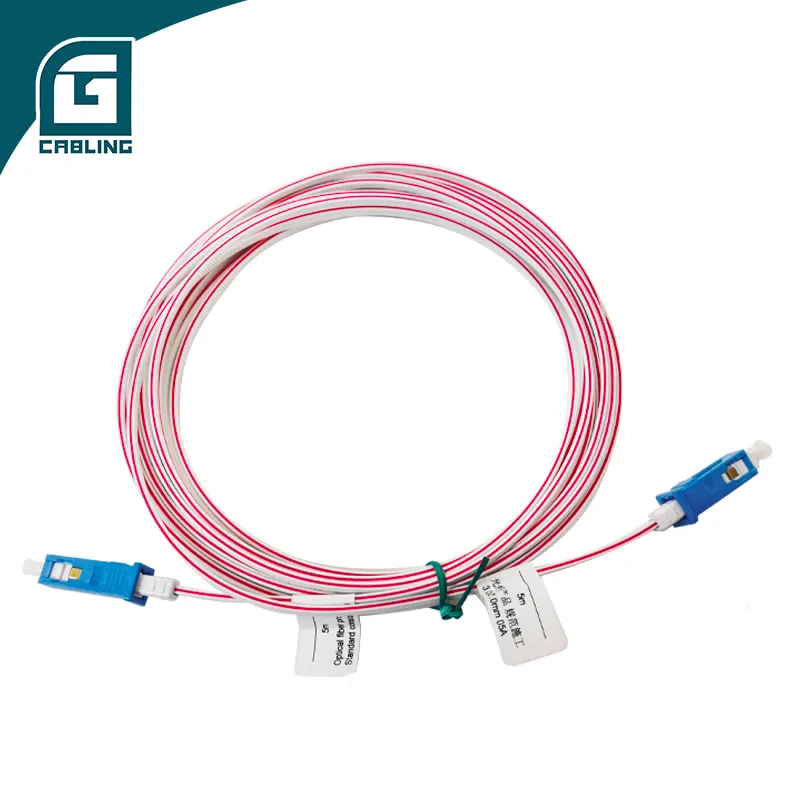
Key Performance and Design Benefits
One of the most significant advantages of hybrid patch cords is installation efficiency. Specifically, replacing two separate cables with one integrated solution greatly reduces deployment time and labor costs. Additionally, fewer cable routes lead to cleaner cable management and improved airflow in network cabinets and equipment rooms.
From a performance perspective, the Gcabling hybrid patch cord delivers reliable optical characteristics. It features low insertion loss (≤0.35 dB) and high return loss (≥50 dB). Furthermore, ceramic ferrules ensure precise optical alignment, which contributes to stable signal quality and long-term durability. Moreover, the reinforced cable structure provides strong tensile performance, supporting secure installations in semi-harsh environments.

Typical Application Scenarios
Photoelectric hybrid patch cords are widely used in IP surveillance systems, where cameras need stable data transmission and continuous power. They are also ideal for wireless access points and telecom access equipment, simplifying network expansion in enterprise and public environments. Moreover, these cables are increasingly adopted in smart transportation systems and intelligent buildings. By supporting IoT devices, sensors, and automation equipment, they provide a single, streamlined cabling solution.
Conclusion
The Gcabling Photoelectric Hybrid Patch Cord offers a practical and future-ready solution for modern network deployment. By combining fiber optics and power conductors in a single cable, it reduces installation complexity and lowers overall project costs. In addition, this integration enhances system reliability. For PoE-based applications, which demand high performance, scalability, and efficient cabling, photoelectric hybrid patch cords represent a clear step forward in network infrastructure design.
Frequently Asked Questions
Q: What is a photoelectric hybrid patch cord?
A:A photoelectric hybrid patch cord is a composite cable that integrates optical fiber for high-speed data transmission and copper conductors for DC power delivery within a single jacket. It allows devices to receive both data and power through one cable instead of two separate lines.
Q: Does the hybrid patch cord support PoE standards?
A:Yes. The Gcabling photoelectric hybrid patch cord supports PoE, PoE+, and PoE++, operating within a 48–56V DC range, making it suitable for high-power network devices such as PTZ cameras and advanced wireless access points.
Q:Will power transmission affect optical signal quality?
A: No. Optical fiber is inherently immune to electromagnetic interference (EMI). The physical separation of fiber and copper conductors inside the hybrid cable ensures stable optical performance with low insertion loss and high return loss.
Q:What are the typical installation benefits?
A: Using a hybrid patch cord reduces the number of cables, conduits, and connection points. This leads to faster deployment, lower labor costs, cleaner cable routing, and easier long-term maintenance.
Q: How is a photoelectric hybrid patch cord different from standard fiber patch cords?
A:Standard fiber patch cords only transmit data and cannot supply power. A photoelectric hybrid patch cord combines fiber and copper conductors, enabling simultaneous data transmission and power supply, which significantly simplifies cabling and installation.

 Spanish
  English
  Arabic
  Portuguese