A high load capacity server cabinet is engineered to safely support extreme static weights, often exceeding a metric ton. By utilizing ultra-thick steel mounting profiles and welded frame construction, these heavy-duty racks prevent structural deformation when housing dense Hyper-Converged Infrastructure (HCI), SAN arrays, and massive centralized UPS battery banks.
As modern data centers shrink their physical footprints while simultaneously increasing compute density, the physical stress placed on IT infrastructure is compounding. A standard network rack is no longer sufficient for housing enterprise-grade hardware. Consequently, specifying a high load capacity server cabinet is a strict engineering requirement for preventing catastrophic structural failures and equipment damage. In this guide, we detail the physical mechanics, material specifications, and primary use cases for deploying heavy-duty enclosures, alongside Gcabling’s premium hardware solutions.
Engineering Heavy-Duty Server Cabinets
Supporting massive static loads requires an uncompromising approach to metallurgical engineering and frame geometry. The entire physical layer—from the load-bearing casters to the vertical mounting rails—must be synchronized to distribute weight evenly and prevent metal fatigue.
The most critical point of failure in a substandard rack is the vertical mounting profile (often referred to as the angle gauge or equipment rail). Under extreme loads from deep, heavy chassis, standard telecom rack profiles will warp. Furthermore, the cage nut cutouts will stretch and strip, causing expensive servers to sag.
High load capacity cabinets solve this by integrating ultra-rigid, thick-gauge steel mounting profiles. This increased steel thickness eliminates shearing risks, ensures perfect horizontal alignment for 4U/8U chassis, and allows frontline installers to mount heavy equipment without fear of thread or rail failure.
Primary Applications for High Load Cabinets
Deploying a heavy-duty cabinet is essential for specific high-density hardware profiles. Network engineers and procurement buyers must mandate these reinforced enclosures for the following applications:
1. Uninterruptible Power Supply (UPS) and Battery Banks
Large-scale UPS systems, particularly those utilizing lead-acid (VRLA) battery strings, introduce massive, concentrated weight at the bottom of a rack. A high load capacity frame safely accommodates this localized load without compromising the structural integrity required to house delicate network switches in the upper U-spaces.
2. Hyper-Converged Infrastructure (HCI) and Blade Servers
Modern blade chassis are exceptionally heavy and require deep, rigid support. A fully populated rack consisting entirely of dual-CPU compute nodes, dense GPU clusters, and Storage Area Network (SAN) arrays requires an infrastructure backbone designed specifically to handle extreme vertical and horizontal stress.
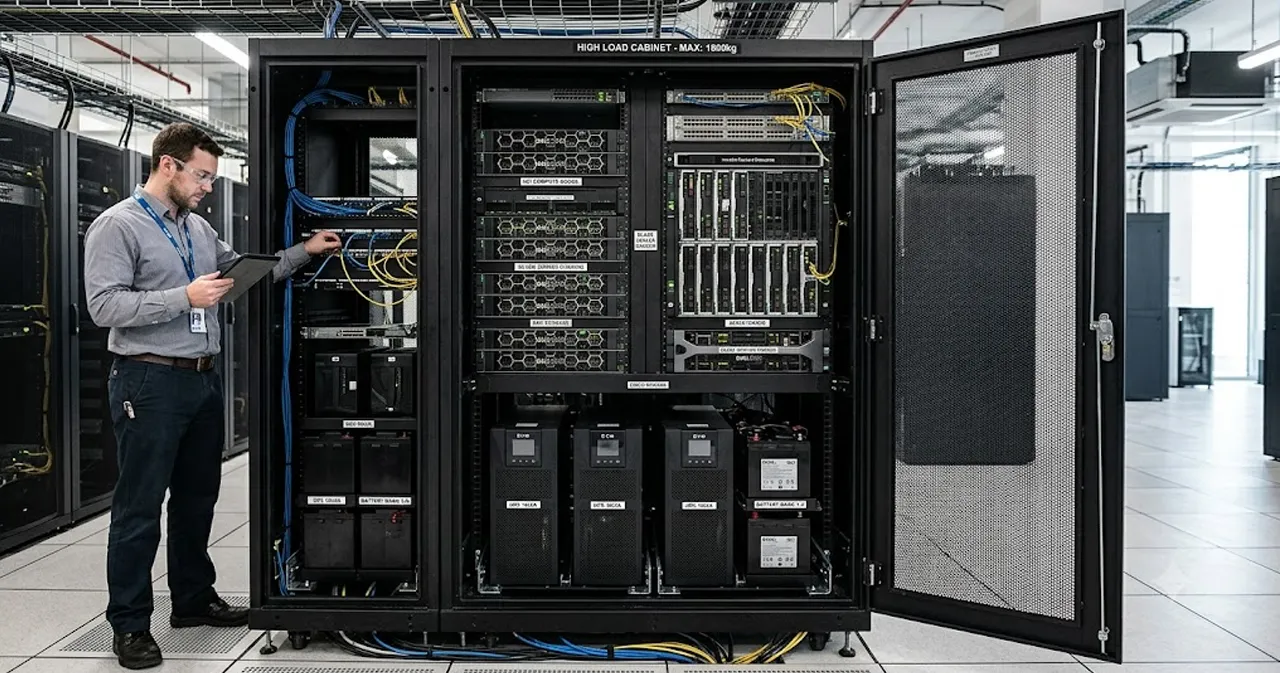
Gcabling’s Premium High Load Cabinet Solutions
Future-proofing your data center requires authoritative, reliable physical infrastructure. Gcabling engineers heavy-duty server cabinets explicitly designed to meet the rigorous demands of enterprise environments.
Our premium enclosures are independently rated for an immense 1500kg static load capacity, safely housing the densest hardware configurations. To completely eliminate rail deformation under heavy torque, we integrate ultra-rigid 2.0mm thick SPCC cold-rolled steel mounting profiles.
To accommodate diverse facility architectures—from edge computing closets to hyperscale data halls—Gcabling offers these high load capacity cabinets in 27U, 42U, and 47U height configurations.
Technical Specifications:
| Característica | Gcabling Specification | Engineering Benefit |
| Static Load Capacity | 1500 kg (3,300 lbs) | Safely houses dense battery banks and fully populated blade servers. |
| Mounting Profile Thickness | 2.0 mm SPCC Cold Rolled Steel | Prevents rail deformation and cage nut stripping under heavy equipment torque. |
| Available Heights | 27U, 42U, 47U | Provides architectural flexibility for edge nodes and centralized hyperscale environments. |
| Hardware Compatibility | ANSI/EIA RS-310-D Standard | Ensures seamless, tool-less integration with all global 19-inch IT equipment vendors. |
By insisting on Gcabling’s high load capacity server cabinet, B2B procurement teams eliminate physical layer risks, reduce Total Cost of Ownership (TCO), and guarantee long-term stability for critical IT investments.
Preguntas Frecuentes
Q: Can I mount heavy UPS battery backups in a standard server rack?
A: No, it is highly dangerous. Standard server racks typically max out around 600kg to 800kg. You must use a high load capacity server cabinet to prevent structural buckling and collapse under the massive, concentrated weight of centralized battery banks.
Q: Why is the thickness of the vertical mounting profile important?
A: It dictates the structural integrity of the installation. Standard thin profiles will warp or strip their cage nut holes under the extreme leverage of heavy servers. Gcabling utilizes 2.0mm thick profiles to ensure rigid, deformation-free support.
Q: Are heavy-duty server cabinets compatible with standard 19-inch equipment?
A: Yes, absolutely. Despite the reinforced multi-folded frame and massive static load ratings, premium heavy-duty cabinets strictly comply with ANSI/EIA RS-310-D standards, ensuring universal mounting compatibility for all standard 19-inch servers and network switches.