
What is FTTH?
FTTH (Fiber to the Home) is an Internet access method that directly connects optical fibers to users’ homes. FTTH uses optical fibers to transmit data, which can provide higher bandwidth and longer transmission distance compared to traditional copper network cables. The optical signal starts from the service provider’s optical line terminal (OLT) and finally arrives at the user’s optical network terminal (ONT) to realize high-speed Internet connection. FTTH, as an efficient and stable connection method, has become an important component of modern communication networks.

How does FTTH Work
FTTH technology establishes a communication channel between the optical line terminal (OLT) in the data center and the optical network unit (ONU) of the end user through an optical distribution network (ODN), achieving effective data transmission.
The ODN network consists of four main subsystems that work together to form the infrastructure of FTTH network, ensuring efficient transmission of optical signals throughout the network.
Feeder Cable Subsystem
Connects the backbone fiber cable to fiber cabinet, typically responsible for long-distance transmission of optical signals.
Distribution Cable Subsystem
Distributes the optical signals from the fiber cabinet to user access points, responsible for the optical signal distribution and connection management.
Household Cable Subsystem
The optical signal is transmitted to the user’s home through FTTH drop cable, responsible for the final segment of optical signal transmission.
Optical Terminal Subsystem
Installed at the user end, responsible for converting optical signals into electrical signals for use by user devices.
FTTH Products
Cable de fibra óptica
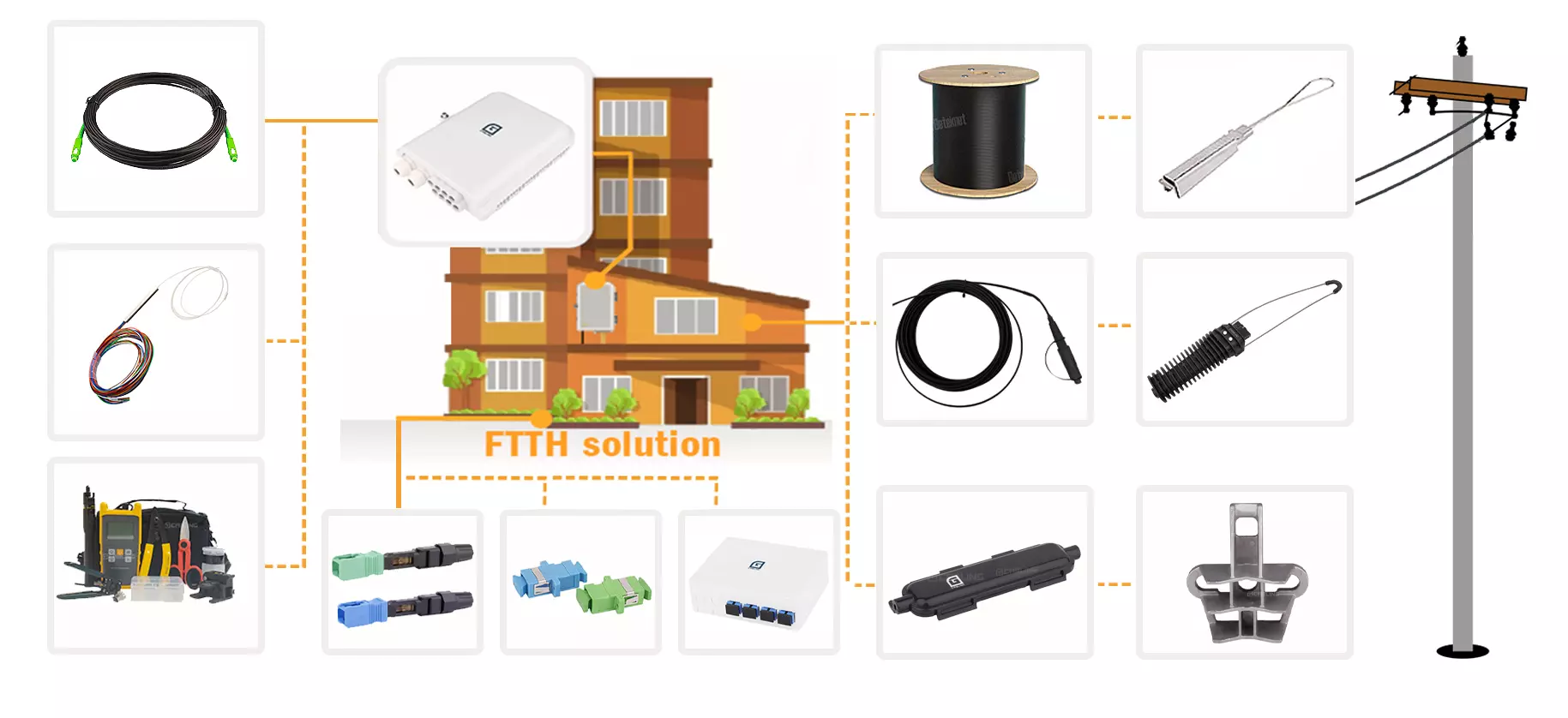
Fiber optic cable is a critical infrastructure in FTTH solutions, responsible for efficient transmission of optical signals. In the entire FTTH network, various types of fiber optic cables are used, including outdoor fiber cables and overhead optical cables, as backbone and distribution cables. In addition, drop cables are used to introduce optical signals from outdoors into indoors, ensuring the stability and reliability of network connections.

Fiber Optic Splitter
Optical splitters are used to distribute optical signals from backbone fibers to multiple users. It can split a single optical signal into multiple signals to meet the needs of multiple users.

Fiber Cabinet
Fiber cabinet is mainly used for the connection, distribution, and management of fiber optic signals, effectively distributing the signals of the backbone fiber to multiple user access points and ensuring the stability of fiber optic connections.

Caja de fibra
Fiber box is mainly used for the wiring connection between optical cables and optical communication equipment, achieving effective connection and signal transmission.

Other Products
In FTTH network links, there are also various fiber optic products ensure the good organization and efficient operation of the entire optical communication system.
ODF: used for managing and connecting different fiber optic lines, providing neat fiber optic connections
Fiber Joint Closure: used to terminate fiber optic cables and provide connections to other devices or cables, ensuring orderly connectivity
Fiber Optic Connector: used for connecting optical fibers to ensure low loss connections and reliable signal transmission.
Fiber Patch Cord: used to connect devices to the network, providing flexibility and ease of installation
Fiber Tool Kit: used for fiber optic installation and maintenance
Fiber Optic Fitting: various hardware components used for fiber optic cable installation, including clamps, brackets, and fixing devices, to ensure the safety and organization of fiber optic cables
Advantages of FTTH
High Speed
FTTH can support extremely high data transmission rates, far exceeding traditional copper cables, meeting the modern user’s demand for high network speeds.
Low Latency
Fiber optic transmission has extremely low latency and provides faster response time, making it suitable for applications that require high real-time performance.
High Bandwidth
Optical fiber has excellent bandwidth and can support multiple applications simultaneously without affecting network performance.
Technological Development
In response to the increasing demand for data, fiber optics can support higher transmission rates and adapt to future development trends by upgrading equipment.
FTTH Application
FTTH is widely used in various scenarios, mainly including home and enterprise users, providing high-speed and stable network access services.
Family users: Meet the internet needs of families and support smart home devices.
Enterprise users: Provide high-speed and stable networks to support internal voice, data, and video communication needs within the enterprise.
Contactar con Gcabling
Gcable provides a comprehensive one-stop FTTH solution with an experienced technical team. We not only provide high-quality fiber to the home products, but also cover the network cabling needs of the entire link. If you are looking for reliable and high-performance FTTH products, Gcabling will provide you with everything you need to build an efficient fiber optic network.

 Spanish
  English
  Arabic
  Portuguese