
Modern data center layout architecture primarily relies on either Top-of-Rack (ToR) or End-of-Row (EoR) designs. ToR places a network switch inside every server rack, minimizing copper cabling by using short DACs. Conversely, EoR centralizes switching at the end of a row, requiring extensive horizontal cable runs but reducing the total number of switches. ToR is the prevailing standard for high-density, scalable 400G/800G environments.
The Evolution of Data Center Layout Architecture
Building a visionary telecommunications infrastructure requires an uncompromising approach to physical topology. The physical arrangement of server cabinets, network switches, and the structured cabling that connects them directly dictates thermal efficiency, bandwidth scalability, and CapEx.
As enterprise facilities transition toward high-density cloud computing, the traditional centralized models face significant bottlenecks. According to Gcabling’s engineering standards, selecting the correct data center layout architecture is the most critical decision an IT director will make during the facility design phase. The two dominant architectural strategies are Top-of-Rack (ToR) and End-of-Row (EoR).
To instantly understand how cabling routing changes between these two topologies, explore the architectural diagram below.
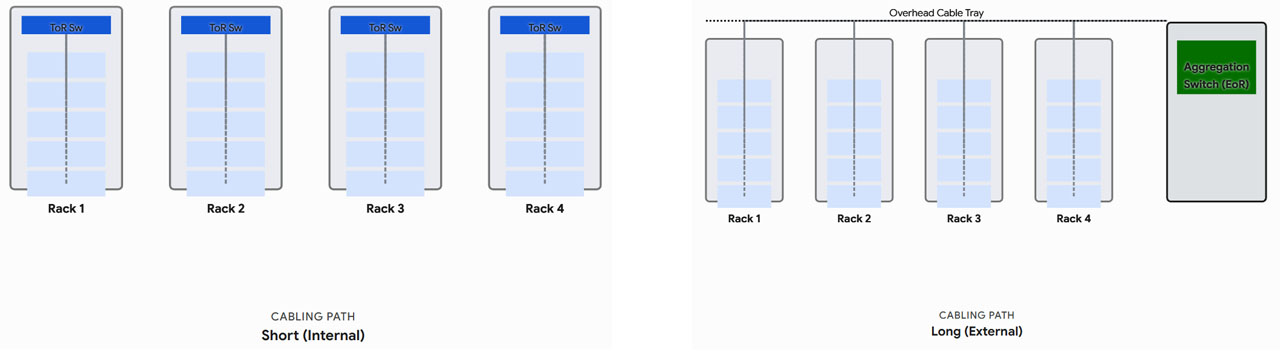
Top-of-Rack (ToR) Architecture
In a Top-of-Rack (ToR) design, a network access switch is installed directly within every single server cabinet (rack). All servers within that specific rack connect to this local switch using short patch cords—typically high-speed Direct Attach Copper (DAC) cables.
The ToR switches then uplink to core or aggregation switches via high-capacity fiber optic trunks (such as OS2 singlemode or OM4 multimode).
Advantages of ToR Design
-
Reduced Copper Cabling: By keeping server-to-switch connections inside the same rack, massive bundles of horizontal copper cables are eliminated. This significantly improves under-floor or overhead airflow for optimal thermal dissipation.
-
Modular Scalability: IT teams can deploy and provision racks individually. This modular approach allows for rapid expansion without disrupting the existing infrastructure.
-
High-Speed Edge Connectivity: Short distances allow for cost-effective 100G and 400G DAC deployments between the server and the switch.
End-of-Row (EoR) Architecture
In an End-of-Row (EoR) configuration, the server cabinets do not contain individual network switches. Instead, all servers within a physical row connect back to a massive, centralized chassis switch located in a dedicated network rack at the end of the aisle.
This topology relies heavily on extensive horizontal structured cabling, typically requiring hundreds of twisted-pair copper cables (like Cat6A) routed overhead or under raised floors.
Advantages of EoR Design
-
Centralized Management: Consolidating the switching infrastructure means fewer individual devices to configure, monitor, and maintain.
-
Lower Switch CapEx: While cabling costs are higher, the facility requires drastically fewer switch chassis and power supplies compared to outfitting every single rack in a ToR model.
Technical Comparison: ToR vs. EoR
To assist enterprise architects in selecting the optimal deployment, we have compiled a definitive structural comparison:
| Architectural Feature | Top-of-Rack (ToR) | End-of-Row (EoR) |
| Switch Location | Inside every server rack | Centralized cabinet per row |
| Server-to-Switch Cabling | Very short (in-rack DAC / AOC) | Very long (horizontal copper runs) |
| Cable Management Complexity | Low (Minimal horizontal bulk) | High (Massive cable bundles) |
| Cooling Efficiency | Excellent (Unobstructed airflow) | Moderate (Thick cable bundles can block air) |
| Port Utilization | Can be low if rack isn’t full | Excellent (Ports shared across the row) |
| Ideal Application | High-density 400G/800G compute | Legacy enterprise, centralized routing |
Elevating Your Infrastructure with Gcabling
Implementing a future-proof data center layout architecture requires premium physical layer components. Whether you are designing a highly modular ToR spine-and-leaf network or maintaining a centralized EoR facility, Gcabling provides authoritative, integrated solutions. Our meticulously engineered MTP/MPO fiber trunks and ultra-low latency DAC cables ensure your architecture easily scales to meet next-generation bandwidth demands.
Frequently Asked Questions
Q: Is Top-of-Rack (ToR) architecture more expensive than End-of-Row (EoR)?
A: Yes, in terms of active hardware CapEx. ToR requires purchasing a network switch for every single server rack, whereas EoR centralizes switching into fewer chassis, though EoR significantly increases the cost of physical cabling.
Q: Can I use Cat6A copper cabling for a modern ToR deployment?
A: No, generally it is not recommended for high-speed ToR. Modern ToR deployments utilizing 100G+ speeds rely almost exclusively on passive Direct Attach Copper (DAC) cables due to their lower latency, negligible power draw, and superior thermal efficiency compared to Base-T copper.
Q: Does End-of-Row (EoR) architecture cause cooling problems in data centers?
A: Yes, it frequently can. The massive bundles of horizontal twisted-pair cables required to connect every server back to the end-of-row switch often obstruct under-floor plenums or overhead pathways, severely degrading HVAC airflow efficiency.

 Spanish
  English
  Arabic
  Portuguese