
Data centers are under ever-increasing pressure to support more connections, higher speeds, and denser cabling infrastructures. As 400G, 800G, and even higher bandwidths become mainstream, the complexity of structured cabling grows significantly. Managing hundreds or thousands of fiber and copper connections manually is no longer sustainable. This is where AI and automation come in: intelligent cabling management can transform how operators monitor, maintain, and scale their physical layer.
Challenges of Traditional Cabling Management
-
High density, high complexity: Modern data centers use dense MPO/MTP fiber trunks and modular patch panels. Without automation, keeping track of every connection, its status, and its changes is very error-prone.
-
Manual errors: Human mistakes—mispatching, poor labeling, unrecorded changes—cause downtime, degraded performance, or long Mean Time to Repair (MTTR).
-
Poor visibility: Many data centers lack real-time, accurate documentation of cabling. Traditional spreadsheets or Visio diagrams are easily outdated and error-prone.
-
Reactive maintenance: Without automation, maintenance is often reactive: operators only respond after a fault has occurred. There’s no predictive insight into which links might degrade.

AI & Automation in Structured Cabling
Here’s how AI and automated systems are being leveraged to modernize cabling management:
Automated Link Detection & Monitoring
-
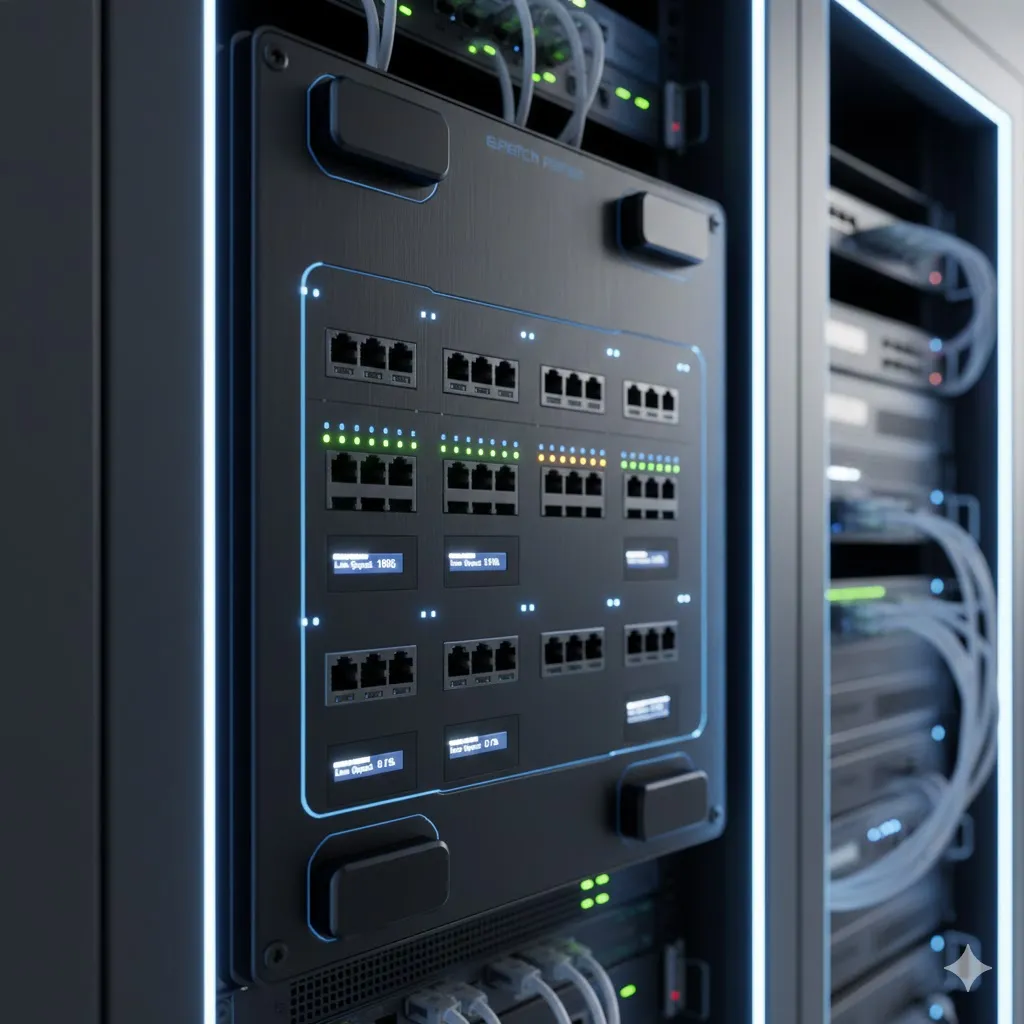
Smart patch panels with built-in sensors or electronics (e‑patch) can detect and report the status of each connection (e.g., whether a port is occupied, unplugged, or faulty).
-
When integrated with a DCIM (Data Center Infrastructure Management) platform, this real-time data becomes part of a living infrastructure model: you always know which fiber or copper link is live, unused, or has an anomaly. Sunbird’s DCIM software provides structured-cabling tracking, patch planning, and live connectivity maps.
-
AI algorithms analyze trends over time to predict failures or signal degradation before outages.
Digital Twin & Predictive Analytics
-
By building a digital twin of the cabling infrastructure, you can simulate changes and predict the impact of reconfiguration. This helps in planning and avoiding risky re-patching.
-
Machine learning models can estimate signal loss or connection degradation based on historical data, enabling predictive maintenance rather than reactive fixes.
-
Some research also explores using digital twin + deep learning to dynamically reconfigure .
Change Management & Automation
-
Use tagged and color-coded cabling systems that align with DCIM identifiers (device, port, patch panel) so that every physical connection is traceable.
-
Automate documentation: when a new patch cord is connected or disconnected, the system records it and updates the DCIM database automatically.
-
Use alerts and alarms when connections are changed unexpectedly, reducing human error.

Benefits of Intelligent Cabling Management
-
Reduced MTTR (Mean Time to Repair): With real-time visibility and predictive insights, teams can identify problem links faster and more accurately.
-
Increased infrastructure reliability: Early detection of degrading links avoids sudden failures.
-
Scalability: As cabling grows, AI helps manage expansion without manual tracking becoming a bottleneck.
-
Operational efficiency: Less manual auditing, fewer mispatches, and better documentation free up human resources.
-
Future proofing: Intelligent management supports future high-speed upgrades (e.g., 400G, 800G), because the physical layer is well mapped and monitored.
Implementation Considerations
When deploying AI-driven structured cabling, consider:
-
Hardware needs: Choose smart patch panels (e-patch), sensors, or modules that support port-level monitoring.
-
Software / Analytics: Integrate DCIM platforms that support cabling, predictive analytics, and change tracking.
-
Data collection and standardization: Make sure each cable / port / connection is correctly labeled, with metadata (cable type, length, endpoints) captured.
-
AI model training: Historical failure or degradation data helps train machine-learning models for better prediction.
-
Security & Governance: Because the cabling database is now “live” and potentially writable, access control, auditing, and change approval workflows are critical.



Future Outlook
-
Deeper AI integration: As AI in data centers matures, cabling systems may become self-optimizing—reorganizing or flagging suboptimal links automatically.
-
Integration with energy efficiency: Cabling intelligence could integrate with power and cooling systems to contribute to green data center strategies (e.g., shutting down or rerouting dormant links).
-
Autonomous digital twins: Real-time digital twin models may reflect not just cable status but physical stress, bend radius, or connector degradation.
-
Industry standardization: Expect more standards around intelligent cabling, automated labeling, and DCIM integration to emerge.
Conclusion
Intelligent, AI-driven structured cabling is no longer a futuristic concept—it’s a practical, high-impact upgrade for modern data centers. By combining smart hardware, DCIM integration, and predictive analytics, operators can dramatically reduce maintenance costs, lower downtime risk, and support future growth with confidence. Investing in this infrastructure today sets the stage for better-managed, more reliable, and future-ready networks.
To Be Gcabling Agent
Becoming a distributor of Gcabling, your success is our mission! As a partner of your network infrastructure products, we provide one-stop services to ensure that you can meet the diverse needs of customers. Our experienced professional team is on standby 24/7, ready to accurately understand your needs and recommend the most competitive fiber optic products for you. We are always committed to creating high returns for our partners! Join Gcabling and embark on a journey of success!

Frequently Asked Questions
Q: What is e-patch (or smart patch panel)?
A: E-patch (electronic patch) refers to patch panels with built-in intelligence—sensors or electronics—that detect port states (connected/disconnected), report real-time usage, and integrate with DCIM systems for live tracking.
Q:How does AI predict cabling failures?
A: By collecting historical data (e.g., signal degradation, disconnections, re-patching events), machine learning models can learn patterns that precede failures and issue alerts before they happen.
Q: Do I need a full DCIM platform to use intelligent cabling?
A: While DCIM integration greatly enhances benefits (real‑time mapping, change tracking), some smart cabling systems can also operate in a more limited mode (e.g., local dashboards), but full DCIM unlocks predictive and scalable capabilities.
Q: Is this suitable only for fiber cabling?
A: No — intelligent cabling management applies to both fiber (MPO, LC) and copper infrastructures. It’s about managing physical connections, not just optical.
Q: How much does this cost to implement?
A: Cost varies based on scale (number of ports), type of smart hardware, and software. While upfront investment is higher, the ROI comes from reduced downtime, fewer manual errors, and lower maintenance costs.

 Spanish
  English
  Arabic
  Portuguese