
What is Optical Fiber?
Optical fiber, as a type of optical transmission medium, utilizes the principle of total reflection of light in glass or plastic fibers to achieve light transmission, and is widely used in modern communication. Singlemode and multimode fibers are two different types of optical fibers. Although both types of optical fibers use light to transmit data, they have some significant differences in structure, performance, and applications, etc.
Singlemode vs Multimode Fiber
| Parameter | Single Mode Fiber | Multimode Fiber |
| Core Diameter | 8-10 μm | 62.5/50 μm |
| Optical Source | Laser | LED or VCSEL |
| No. of Propagating Mode | One | Hundreds |
| Bandwidth | More | Less |
| Transmission Speed | Fast | Slow |
| Transmission Distance | Long | Short |
| Attenuation | Less | More |
|
Modal Dispersion |
Small | Large |
|
Wavelength |
1310nm and 1550nm | 850nm and 1300nm |
|
Application Field |
MAN, WAN, long distance fiber optic communication | LAN, data center |
Core Diameter
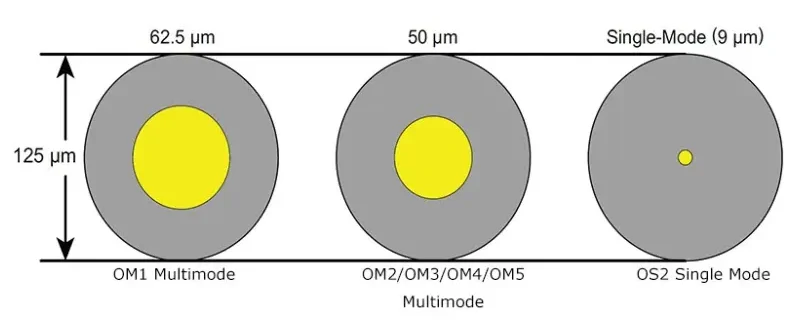
The structure of single mode and multimode optical fibers is composed of a core, cladding, and coating, with an outer diameter of 125μm. The main difference lies in their core diameter. The core diameter of single-mode fiber is relatively small, usually 9μm, while the core diameter of multimode fiber is much larger, typically 50μm or 62.5μm.
Optical Source
There are also differences in the optical sources used for transmitting data in fiber optic cables between single mode fiber and multimode fiber. Single mode fiber uses laser light sources, with commonly used wavelengths of 1310nm and 1550nm, which perform well in terms of transmission loss and bandwidth. Multimode fiber, on the other hand, uses more LED and VCSEL, with commonly used wavelengths of 850nm and 1300nm, which can generate wider beams and are suitable for larger core diameters in multimode fiber.
Light Propagation Mode
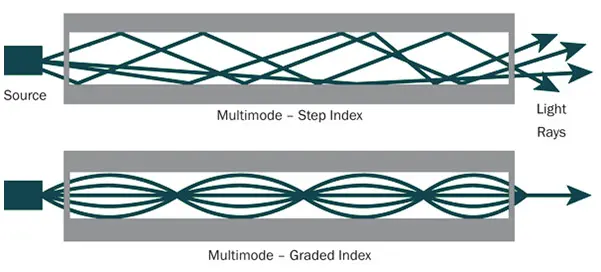
Single mode fiber, due to its small core diameter, allows light to propagate in only one mode within the fiber. This characteristic results in extremely low intermodal dispersion, making optical signal transmission more stable and maintaining high quality over long distances. Multimode fibers have a larger core diameter, allowing light to propagate in multiple modes simultaneously and perform well in short distance transmission. However, due to the difference in propagation speed between different modes, this also leads to a significant impact of intermodal dispersion on signal quality.

Transmission Distance and Bandwidth
Single mode fiber allows only one mode of light propagation, with almost no intermodal dispersion, providing a wider bandwidth. In addition, the small core diameter of single-mode fiber helps to reduce light refraction and scattering, resulting in lower attenuation of signals during transmission, making single-mode fiber outstanding in long-distance communication. However, multimode fiber supports multiple modes of light propagation, resulting in greater dispersion and therefore a relatively narrower bandwidth. As the transmission distance increases, the impact of intermodal dispersion can degrade the quality of signal, making its effective transmission distance shorter compared to single-mode fiber.
Application Scenarios
From the above introduction, it can be seen that single-mode fiber has the characteristics of low intermodal dispersion, low signal attenuation, and high bandwidth, making it very suitable for long-distance data transmission. Therefore, singlemode fiber is usually used in MAN, WAN, FTTx, long-distance communication, etc. Multimode fiber supports multiple propagation modes and can flexibly support different transmission requirements. Multimode fiber is widely used in short distance applications such as LAN, data centers, and enterprise networks.
- Know more about single mode fiber: Single Mode Fiber: G652D vs G657A1 vs G657A2
- Know more about multimode fiber: Multimode Fiber: OM1 vs OM2 vs OM3 vs OM4 vs OM5
Single Mode and Multimode Fiber: Which is Better
When choosing between single mode and multimode fiber, it is not easy to simply say which is better, as singlemode and multimode fibers have their own advantages and disadvantages. When making a choice, it is necessary to comprehensively consider factors such as specific application requirements, transmission distance, bandwidth requirements, and cost. If you need to transmit signals over long distances and have high bandwidth requirements, then single mode fiber should be chosen. If you need to transmit short distance signals, you can choose multimode fiber. In different application scenarios, both types of optical fibers can be suitable choices.
للتواصل مع Gcables
Gcabling has a professional fiber optic cable product portfolio and technical team. Our fiber optic cables and patch cords are made with high-quality optical fibers, and the manufacturing process strictly follows IQC, IPQC, FQC, DQC, and OQC procedures, along with rigorous inspections. Whether you need single-mode fiber optic cables or multimode fiber optic cables, please contact us. We are ready to serve you at any time.

 Arabic
  English
  Spanish
  Portuguese