
Gcabling | Network Infrastructure Solutions & Products Supplier
Welcome to be our agent!
Why MPO Polarity Matters: Ensuring Proper Tx/Rx Alignment
In high-density fiber optic networks, ensuring that transmit (Tx) signals align correctly with receive (Rx) ports is crucial. This principle becomes more complex when dealing with multi-fiber MPO (Multi-Fiber Push-On) connectors, which typically house 12, 24, or even 48 fibers in a single interface.
Polarity refers to the mapping of these fibers from one end of a connection to the other. Mismanaging polarity can lead to communication failures, network downtime, and costly troubleshooting. That’s why understanding MPO polarity and planning for it during installation is vital for any data center or enterprise network deployment.
Understanding MPO Polarity Types: A, B, and C
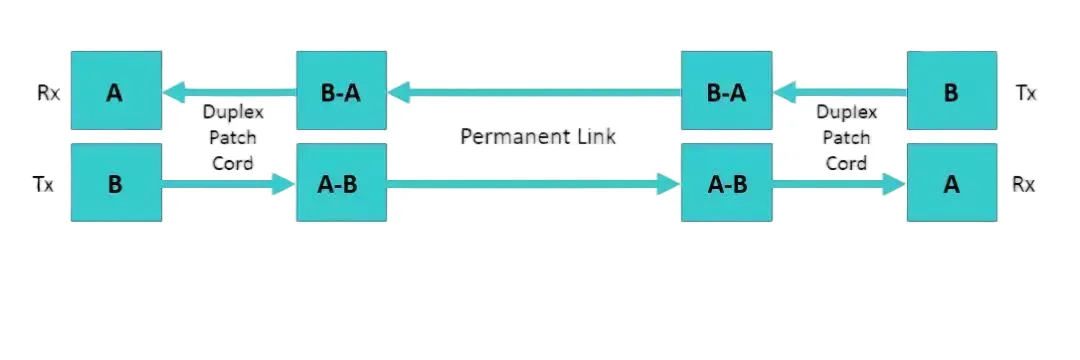
The three methods defined by the TIA 568 standard to ensure the correct polarity of optical fibers are named Method A, Method B, and Method C. To comply with these standards, three types of MTP optical fibers with different structures are currently in use, namely Type A, Type B, and Type C, for three different connection methods. First, the three different cables and three connection methods are introduced.
Type A – Straight-through
The MPO trunk cable has a key-up connector on one end and a key-down connector on the other end so that the fiber at position 1 (Tx) reaches position 1 (Tx) at the other end.

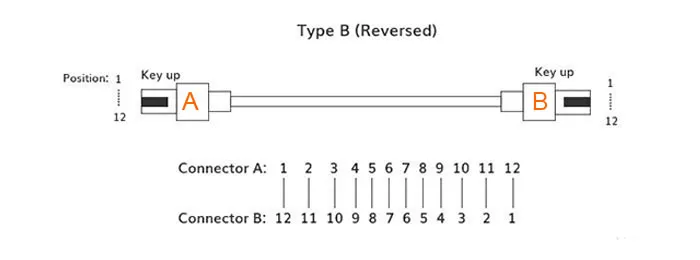
Type B – Reversed
Key Up connectors are used at both ends to achieve transceiver-receiver flipping, so that the fiber at position 1 (Tx) goes to position 12 (Rx) at the other end, the fiber at position 2 (Rx) goes to position 11 (Tx) at the other end, and so on.
Type C – Pairwise Flip
A key-up connector is used on one end and a key-down connector is used on the other end – but the flipping happens inside the cable, with each pair of fibers flipped so that the fiber in position 1 (Tx) goes to position 2 (Rx) at the other end, and the fiber in position 2 (Rx) goes to position 1 (Tx).

Trunk vs Breakout Cable Use Cases
MPO trunk cables connect two MPO interfaces and are commonly used in backbone or horizontal cabling. They maintain high-density connections with minimal fiber clutter.
Breakout cables split an MPO connector into multiple simplex connectors (like LC or SC), ideal for connecting core switches or transceivers with standard SFP ports.
Example Scenarios:
-
Trunk + Cassettes: Used in modular systems with patch panels.
-
Trunk + Breakout: Common in Top-of-Rack (ToR) or Leaf-Spine architectures.
-
Direct MPO-MPO Links (Type B): Preferred in hyperscale or AI server environments.
How to Avoid MPO Polarity Errors
Avoiding polarity mismatches requires a systematic approach:
- Design the Fiber Path First
Use detailed polarity diagrams and document each trunk and cassette type. - Label and Test Everything
Mislabeling causes confusion during troubleshooting. Always label both ends and verify with polarity testers. - Use Compatible Components
Make sure cassettes, trunk cables, and adapters are all designed to work together based on polarity type. - Use Polarity-Reversible Modules
Many MPO cassettes or connectors now allow field polarity switching (ideal for last-minute corrections).
Polarity Conversion Modules and Adapters
When polarity errors are unavoidable or legacy infrastructure needs adaptation, these tools help:
-
Polarity-Reversible MPO Cassettes
Allow switching between Type A and Type B within the cassette. -
Key-Up/Key-Down MPO Adapters
Change fiber orientation by rotating connector alignment. -
Field Configurable MTP® Connectors
Enable technicians to flip polarity on-site without special tools.
الخاتمة
MPO polarity may seem complex, but it’s manageable with proper design, documentation, and quality components. Whether you’re deploying 100G, 400G, or AI-ready infrastructure, polarity planning ensures reliable performance and fast deployment.

 Arabic
  English
  Spanish
  Portuguese